Skip to main content Skip to footer
Introduction: The Rising Cost of Drilling Modern Tiles
In today’s high-end construction market, the shift towards Sintered Stone and high-hardness Glazed Porcelain is undeniable. While these materials deliver a premium look, they present a massive technical hurdle: with a Mohs hardness of 6-8, they are notoriously difficult to drill.
Mastering High-Density Materials: The Ultimate Chip-Free Solution Contractors frequently ask how to drill porcelain tile without cracking, especially when handling expensive large format slabs. Traditional tools often fail under the intense thermal friction generated by hard ceramics. This is exactly where Vacuum Brazed Diamond Core Bits step in. Designed specifically as the ultimate dry diamond drill bit for porcelain, these tools bypass the need for messy water containment, delivering surgical precision and a flawless finish on the toughest commercial job sites.
For distributors and contractors, the challenge isn’t just drilling a hole—it’s doing so without breaking the bank or the tile. The industry is moving away from traditional water-cooled methods toward efficient Dry Drilling solutions that offer longevity. This report analyzes a field test from Germany that demonstrates why Vacuum Brazed Diamond Drill Bits are becoming the new B2B standard.
1. The Real-World Scenario: Precision Meets Hardness
The Project Profile
- Location: Munich, Germany (A market demanding high engineering standards).
- Client: Mark D., a renovation specialist with two decades of experience.
- The Task: Installing fixtures in a luxury apartment, requiring hundreds of 6mm anchor holes in premium Italian Porcelain Tile.
The Stakes Drilling into installed, high-value porcelain is risky. The material is extremely brittle. A single slip or crack doesn’t just ruin a drill bit; it ruins an expensive tile, causing project delays and costly rework. Mark needed a tool that guaranteed zero damage.

2. The “Electroplated Trap”: Why Cheap Bits Cost More
Before upgrading his inventory, Mark’s team relied on standard Electroplated Diamond Bits to minimize upfront tool costs. However, the field test revealed high hidden costs:
- Rapid Failure Rate: The bits lost their cutting ability after just three holes. Electroplating merely “sticks” diamonds to the surface; under the friction heat of dry drilling, this layer strips away effortlessly.
- Thermal Damage Risk: With poor cutting efficiency, operators were forced to apply heavy pressure. Without water, this led to instant burnout and thermal shock, risking tile cracks.
- Poor Finish Quality: The most critical issue was the “chipping” or jagged edges around the holes caused by vibration. For a luxury finish, this was unacceptable.
Mark concluded that “budget” tools were actually inflating his labor and material costs.
3. The Technical Upgrade: Vacuum Brazed Technology Explained
To solve these pain points, we introduced the Hex Shank 6mm Vacuum Brazed Core Drill Bit. Unlike sintered or electroplated options, this tool is engineered specifically for the rigors of Dry drilling hard materials.
Why It Works:
- Metallurgical Bonding: Vacuum Brazing chemically bonds the diamond particles to the steel matrix. They don’t just sit on top; they are embedded, offering superior heat resistance.
- Non-Slip Drive: The Hex Shank design is crucial for hard porcelain, ensuring 100% torque transfer and eliminating chuck slippage.
- Thermal Management: An integrated high-grade Cooling Wax core self-lubricates the tip, while the external U-groove design ejects hot debris rapidly.
4. Field Test Data: Efficiency Up by 200%
Mark’s on-site video documented the performance of the vacuum brazed bits across three key metrics:
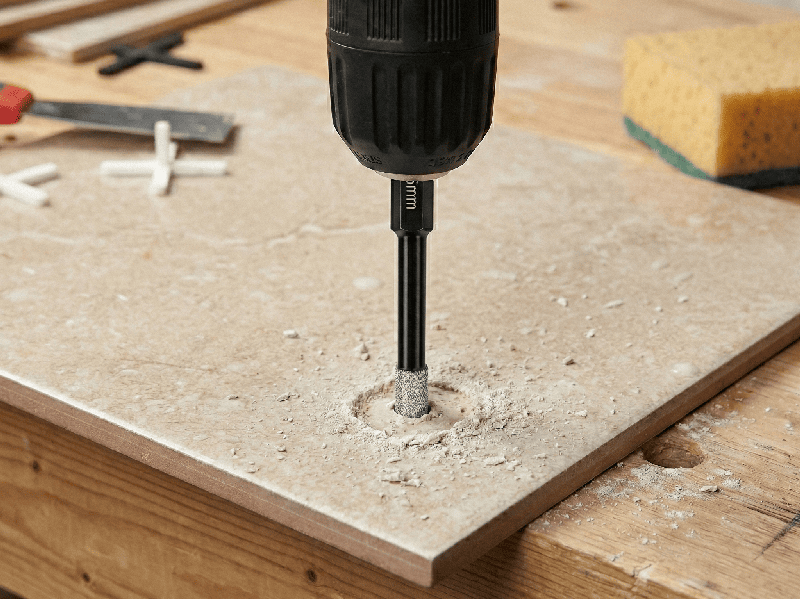
- Start-Up Precision: Even without a centering guide, the exposed diamond edges bit into the glaze instantly. There was no “skating” across the tile surface.
- Penetration Speed: The bit drilled through 10mm of hard porcelain in seconds. Red dust (tile body) was ejected smoothly via the spiral grooves, preventing clogging. Mark estimated a 200% increase in efficiency.
- Hole Quality: The result was a perfectly round, clean hole with No Broken Edges, preserving the integrity of the expensive glaze.
5. Comparative Analysis: Brazed vs. Electroplated
Following the test, Mark switched his bulk procurement to Vacuum Brazed Tile hole cutters, noting that a single bit could last for over 30 holes.
Vacuum Brazed vs. Electroplated: The Engineering Difference. When evaluating Vacuum Brazed vs Electroplated Diamond Bits, the difference lies entirely in the bonding mechanism. Electroplated bits rely on a simple mechanical grip that easily strips under high torque. In contrast, the remarkable heat resistance of vacuum brazed diamond tooling is achieved through a high-temperature chemical metallurgical bond. This fusion securely anchors the diamond grit, making it far superior when comparing vacuum-brazed vs sintered diamond drill bits for fast, dry applications. Whether you are mounting angle grinder diamond core bits or utilizing heavy-duty 5/8″-11 thread diamond core bits for US grinders, this technology guarantees maximum torque transfer without catastrophic segment loss.
Here is the technical breakdown for industry buyers:
| Feature | Vacuum Brazed Bit (The Solution) | Electroplated Bit (The Problem) |
| Diamond Bond | Chemical/Metallurgical: Diamonds embedded in matrix. Hard to strip. | Physical: Surface coating only. Peels under heat. |
| Best Application | High-intensity Dry Drilling without water. | Requires constant water cooling or fails. |
| Diamond Exposure | High (70-80%) for aggressive cutting. | Low exposure, leads to slipping. |
| Lifespan | 3-5x Longer than traditional bits. | Disposable, extremely short life. |
6. Pro Tips for Maximum Longevity
To help your customers get the same results as Mark, educate them on these usage techniques:
- The Orbital Technique: When dry drilling, use a slight “wobbling” motion. This helps eject debris and allows air to cool the core.
- RPM Matters: High-speed drills (2000-3000+ RPM) or angle grinders perform best. Speed reduces vibration.
- Air Cooling: Spin the bit in the air for a few seconds between holes to dissipate heat.
Field Test Results: Superior Speed and Thermal Management In our latest field tests, professionals noted a drastically faster penetration rate in porcelain tile drilling. The secret weapon behind this efficiency? Wax filled cooling diamond drill bits. These specialized tools feature an internal solid wax core that melts upon friction, automatically lubricating the cutting edge and absorbing excess heat. This actively prevents the drill bit from wandering and allows for high speed dry core drilling in hard vitrified tiles—making it the best diamond core bit for granite countertops and hard ceramics without requiring a single drop of external water.
Conclusion: Quality Tools Build Reputations
Mark’s experience confirms a vital rule in the tool industry: Cheap tools are the most expensive option. By switching to Vacuum Brazed Diamond Drill Bits, the contractor reduced overall project drilling costs by roughly 40%.
For hardware retailers and distributors, stocking high-performance vacuum brazed tools is a proven way to build professional trust and reduce returns.
Ready to upgrade your inventory? Ensure your clients achieve the perfect finish every time. Contact us today for our latest B2B price list and OEM customization options for vacuum brazed drilling solutions.
B2B Sourcing Notice: Scale Your Commercial Fleet with Confidence Minimizing jobsite downtime requires highly consistent, industrial-grade consumables. As a verified vacuum brazed diamond core bit manufacturer, we provide precision-engineered solutions tailored for global distribution networks. Whether you are looking for wholesale vacuum brazed diamond tools to supply your retail network, or need custom OEM private label tile drill bits to elevate your brand identity, our factory has you covered. Contact our engineering team today for bulk procurement dry diamond core drill bits and equip your commercial fleet with the industry’s highest-rated cutting technology.