Skip to main content Skip to footer

Best Drill Bits for Concrete and Reinforced Concrete: Complete Selection Guide
The best drill bit depends on the hole diameter and whether the concrete contains rebar. For small anchor holes, carbide-tipped SDS Plus or SDS Max bits are generally suitable. For larger, deeper or reinforced-concrete holes, diamond core drill bits provide cleaner and more efficient drilling.
| Drilling Task | Recommended Bit | Typical Application |
|---|---|---|
| Small holes | Carbide / SDS Plus | Anchors, screws |
| Medium/deep holes | SDS Max | Structural fixing |
| Large round holes | Diamond core bit | Pipes, HVAC |
| Reinforced concrete | Laser welded diamond core bit | Concrete + rebar |
| Water available | Wet core bit | Heavy-duty drilling |
| Water restricted | Dry core bit | Short/shallow holes |
SDS Drill Bit vs Diamond Core Bit: Which One Should You Use?
Choosing between an SDS drill bit and a diamond core bit mainly depends on the hole diameter, drilling depth, concrete condition, and whether the material contains steel reinforcement. Both tools are widely used for concrete drilling, but they are designed for different applications.
For small anchor holes and general fastening work, an SDS concrete drill bit is usually the more practical choice. For larger, cleaner, and deeper holes—especially in reinforced concrete—a diamond core drill bit is generally more suitable.

SDS Concrete Drill Bits
SDS drill bits are commonly used with hammer drills and rotary hammers for drilling small to medium-sized holes in concrete, brick, and masonry.
Most SDS concrete drill bits feature a carbide tip that helps break and remove hard mineral material while the hammering action of the machine improves drilling efficiency.
The two most common connection systems are:
- SDS Plus – typically used for lighter-duty drilling and smaller diameter holes.
- SDS Max – designed for heavier-duty rotary hammers and larger or deeper holes.
SDS concrete drill bits are especially suitable for applications such as:
- Anchor holes
- Bolt holes
- Mechanical fasteners
- Wall plugs
- Small electrical installation holes
- General construction and renovation work
For contractors who mainly need to drill small holes for anchors, bolts, or fixing systems, an SDS drill bit is usually faster, simpler, and more economical than using a diamond core drilling system.
However, conventional SDS carbide bits are not designed for efficiently cutting through large sections of steel reinforcement. When the drilling path contains heavy rebar or when a large-diameter opening is required, a diamond core bit may provide a better solution.
Diamond Core Drill Bits
Diamond core drill bits are designed for producing clean, round holes in concrete, reinforced concrete, masonry, and other hard construction materials.
Instead of removing all the material inside the hole, a core bit cuts around the outer circumference and leaves a cylindrical concrete core. This drilling method reduces material removal and makes diamond core drilling especially efficient for larger diameter holes.
Diamond core drill bits are commonly used for:
- Plumbing pipe penetrations
- HVAC installation
- Electrical conduit openings
- Drainage systems
- Utility installation
- Concrete sampling
- Large structural openings
For reinforced concrete applications, professional diamond core bits can also cut through embedded rebar, depending on the segment design, bond formulation, welding technology, machine power, and drilling conditions.

Diamond core bits are available for both wet drilling and dry drilling.
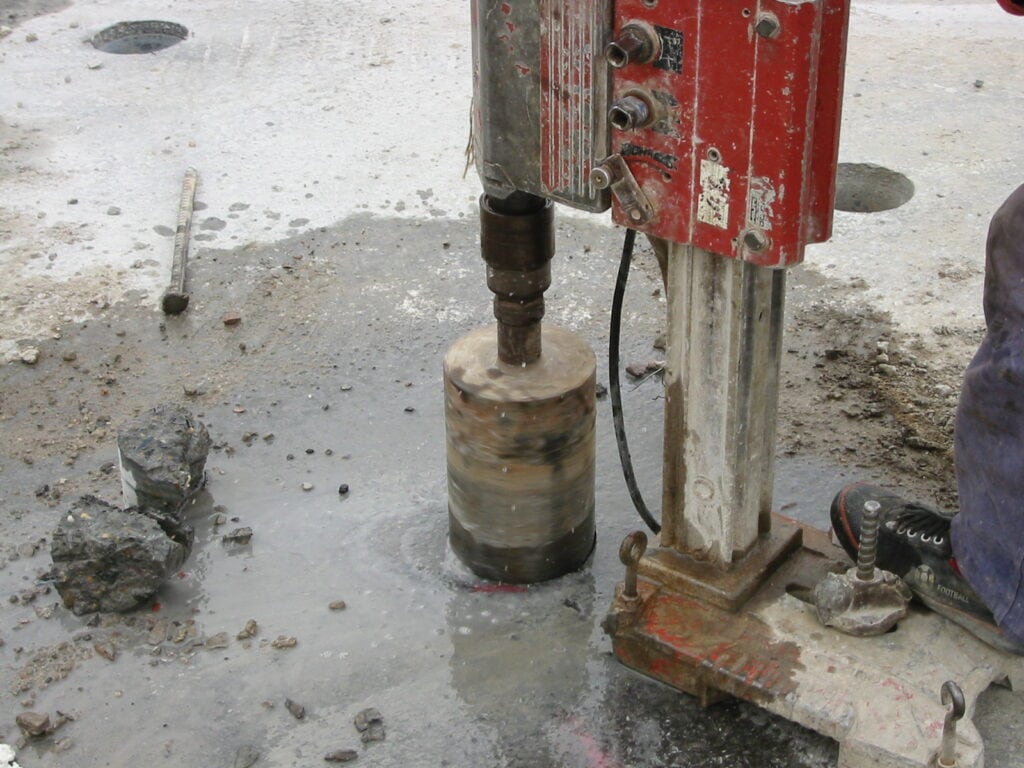
Wet diamond core drilling uses water to cool the diamond segments, reduce dust, and remove slurry from the drilling area. It is commonly used for deep holes, large diameters, and demanding reinforced concrete applications.
Dry diamond core drilling does not require continuous water supply, making it convenient for indoor work, renovation, or locations where water use is restricted. However, dry drilling generally creates more heat and dust, so choosing the correct bit and machine is especially important.
SDS Drill Bit vs Diamond Core Bit Comparison
| Feature | SDS Drill Bit | Diamond Core Bit |
|---|---|---|
| Typical Hole Size | Small to medium | Medium to large |
| Cutting Method | Hammering and carbide cutting | Diamond abrasive cutting |
| Common Equipment | Hammer drill / rotary hammer | Core drill machine |
| Best For | Anchors, bolts, fasteners | Pipes, HVAC, conduit, large openings |
| Hole Finish | Standard drilled hole | Clean, round core hole |
| Reinforced Concrete | Limited depending on rebar | Better suited for reinforced concrete |
| Rebar Cutting | Not ideal for heavy rebar | Suitable with the correct core bit |
| Wet / Dry Options | Mainly dry | Wet and dry options available |
In simple terms, use an SDS concrete drill bit for small fastening holes, and choose a diamond core drill bit when you need a larger, cleaner hole or need to drill through reinforced concrete containing rebar.
For more detailed information about drilling through reinforced concrete and steel reinforcement, read our guide on how to drill through concrete and rebar.
Best Drill Bit for Reinforced Concrete and Rebar
Reinforced concrete is more difficult to drill than ordinary concrete because it combines two very different materials: hard mineral aggregate and embedded steel reinforcement.
A drill bit that performs well in concrete does not necessarily perform well after reaching rebar. For this reason, contractors should consider both the concrete strength and the amount of steel reinforcement before selecting a drilling tool.
For small fastening holes, carbide-tipped masonry or SDS drill bits may be sufficient. For larger openings, deeper drilling, or applications involving significant reinforcement, a professional diamond core drill bit is usually a more efficient option.
Why Ordinary Masonry Bits Struggle with Rebar
Standard masonry drill bits are designed mainly to crush and remove concrete, brick, and other mineral-based materials.
Most use carbide cutting tips combined with the hammering action of a rotary hammer. This works well when drilling through normal concrete, but performance can drop significantly once the bit reaches steel reinforcement.
Common problems include:
- Reduced drilling speed
- Excessive heat
- Premature carbide-tip wear
- Increased vibration
- Difficulty progressing through the hole
- Higher risk of damaging the bit
For occasional small-diameter holes, contractors may use a dedicated rebar cutter after locating the steel. However, this requires changing tools and can slow down the drilling process.
For larger diameter openings in reinforced concrete, a diamond core drill bit is generally better suited because it can cut both the concrete matrix and embedded reinforcement as part of the same drilling process.
Why Diamond Core Bits Are Better for Large Holes
Diamond core drill bits use industrial diamond segments attached around the edge of a steel barrel.
Instead of pulverizing all the material inside the hole, the core bit cuts only around the circumference. This leaves a cylindrical core in the center and greatly reduces the amount of material that needs to be removed.
This drilling method offers several advantages for large-diameter concrete holes:
- Faster material removal
- Cleaner and more accurate hole edges
- Lower vibration compared with heavy percussion drilling
- Better control when drilling large openings
- Suitable for deep holes
- Suitable for reinforced concrete
- Wide range of available diameters
Diamond core bits are commonly used for plumbing, drainage, HVAC, electrical installations, utility penetrations, and structural openings.
When drilling heavily reinforced concrete, segment specification is especially important. The correct diamond concentration, bond hardness, segment shape, welding method, and machine parameters all affect drilling speed and bit life.
Laser-Welded Diamond Segments
For demanding reinforced concrete drilling, laser-welded diamond core bits are widely used because laser welding provides a strong connection between the diamond segment and the steel barrel.
During drilling, diamond segments are exposed to heat, friction, vibration, and impact from aggregate and embedded steel.
A strong segment connection helps reduce the risk of segment detachment under demanding working conditions.
Laser-welded diamond core bits are commonly selected for:
- Reinforced concrete
- Hard concrete
- Concrete with steel reinforcement
- Large diameter drilling
- Deep hole drilling
- Professional wet core drilling
However, welding technology is only one part of the overall performance. The quality of the diamond segment, metal bond, steel barrel, welding consistency, and drilling parameters are equally important.
How to Choose the Right Concrete Drill Bit Size
Choosing the correct drill bit diameter is one of the most important steps before drilling concrete.
The size of the hole determines not only the drill bit but also the machine type, drilling method, connection system, power requirement, and cooling method.
Before drilling, always confirm the required finished-hole diameter, drilling depth, concrete condition, and whether reinforcement is present.
Small Anchor Holes
Small holes are commonly required for:
- Wall plugs
- Expansion anchors
- Concrete screws
- Mechanical fasteners
- Brackets
- Frames
- Fixtures
For these applications, carbide-tipped SDS Plus drill bits are commonly used.
Typical small-hole drilling does not normally require a diamond core drilling machine because SDS tools are fast, economical, and easy to operate.
For harder concrete or larger anchor sizes, SDS Max drill bits may provide additional power and durability.
The drill bit diameter should always match the anchor or fastener manufacturer’s specification.
Using a hole that is too large may reduce holding strength, while a hole that is too small may make installation difficult.
Medium and Deep Holes
Medium-diameter or deep holes require more attention to drilling depth, machine power, and dust removal.
Depending on the application, contractors may use:
- SDS Max drill bits
- Long masonry drill bits
- Hollow drill bits
- Diamond core bits
Long holes generate more friction and make debris removal more difficult. Poor dust removal can increase heat and reduce drilling efficiency.
For deep drilling in hard or reinforced concrete, core drilling may become more efficient because only the perimeter of the hole is cut.
When choosing a bit for deep holes, check:
- Required drilling depth
- Barrel length
- Extension rod compatibility
- Machine power
- Cooling method
- Connection thread
Large Diameter Core Holes
Large-diameter holes are where diamond core drill bits provide the greatest advantage.
Typical applications include:
- Plumbing pipes
- Drainage pipes
- HVAC ducts
- Electrical conduit
- Utility lines
- Ventilation openings
- Concrete sampling
Diamond core bits are available in a very wide range of diameters.
For large holes, it is especially important to match the core bit diameter with:
- Core drill machine power
- Recommended RPM
- Drilling stand capacity
- Arbor or spindle thread
- Concrete hardness
- Reinforcement level
Large-diameter drilling generally requires lower rotational speed and higher torque than small-diameter drilling.
Using the wrong machine speed can reduce drilling efficiency and shorten segment life.
Wet vs Dry Diamond Core Drilling
Diamond core bits are generally divided into two main categories: wet core bits and dry core bits.
Both can be effective when used in the correct application, but they operate under different conditions and require different segment designs.
The best choice depends on the drilling location, hole diameter, material, water availability, dust-control requirements, and equipment.
Wet Core Bits
Wet diamond core drilling uses water during the drilling process.
The water helps cool the diamond segments and barrel while also removing concrete slurry from the cutting area.
Wet drilling is commonly preferred for demanding applications such as:
- Reinforced concrete
- Hard concrete
- Large diameter holes
- Deep drilling
- Continuous professional drilling
- Concrete containing heavy reinforcement
Major advantages of wet core drilling include:
- Better segment cooling
- Reduced airborne dust
- More stable cutting temperature
- Efficient slurry removal
- Longer bit life under demanding conditions
- Suitable for deep holes
- Better performance in heavily reinforced concrete
Wet core drilling is widely used in commercial construction, structural work, infrastructure, plumbing, and professional concrete cutting.
The main limitation is the need for a controlled water supply and slurry-management system.
Dry Core Bits
Dry diamond core bits are designed to operate without continuous water cooling.
They are commonly used where water is unavailable or where wet drilling would create cleanup or site-management problems.
Typical dry-drilling applications include:
- Indoor renovation
- Masonry
- Brick
- Concrete block
- Limited-depth concrete drilling
- Electrical and installation work
Dry drilling offers several practical advantages:
- No external water supply required
- Faster jobsite setup
- Cleaner for water-sensitive areas
- Convenient for short drilling jobs
- Easier mobility between work areas
However, dry drilling generates more heat and dust than wet drilling.
For this reason, proper airflow, dust extraction, drilling speed, and intermittent cooling periods are important.
Dry drilling in reinforced concrete should only be carried out with a core bit specifically designed for that material and application.
Wet vs Dry Core Drilling Comparison
| Feature | Wet Core Drilling | Dry Core Drilling |
|---|---|---|
| Cooling Method | Water | Air |
| Dust Level | Lower | Higher |
| Drilling Depth | Suitable for deep drilling | Better for short to medium holes |
| Reinforced Concrete | Highly suitable | Depends on bit design |
| Large Diameter Holes | Excellent | More limited |
| Segment Temperature | Lower | Higher |
| Bit Life | Generally longer in heavy-duty use | Depends strongly on cooling |
| Jobsite Setup | Requires water management | Faster setup |
| Indoor Renovation | Requires slurry control | Often more convenient |
| Professional Structural Work | Commonly used | Application-dependent |
How Diamond Segment Design Affects Drilling Performance
The diamond segment is the main cutting component of a diamond core drill bit.
Although two core bits may look similar from the outside, differences in diamond grade, concentration, bond formulation, segment shape, and manufacturing process can produce very different drilling performance.
A properly matched segment can improve cutting speed, stability, and working life.

Diamond Bond
Industrial diamond particles are held inside a metal bond.
As the segment wears, the bond gradually exposes new diamond particles.
The balance between diamond wear and bond wear is critical.
If the bond is too hard for the material, the segment may glaze because new diamonds are not exposed quickly enough.
If the bond is too soft, the segment may wear too quickly.
In general, segment formulations are selected according to:
- Concrete hardness
- Aggregate type
- Reinforcement level
- Machine power
- Wet or dry drilling
- Desired drilling speed
- Expected tool life
This is why professional diamond tool suppliers often use different segment formulas for different markets and materials.
Segment Shape
Diamond core drill bit segments are available in different shapes.
Common designs include:
- Standard rectangular segments
- Turbo segments
- Crown-shaped segments
- Roof-top segments
- Ribbed segments
Segment shape affects how quickly the core bit starts cutting, how slurry escapes, how heat is dissipated, and how stable the bit feels during drilling.
For example, a crown or roof-top segment can provide a smaller initial contact area, helping the bit start drilling more easily.
Turbo or ribbed segment designs may improve debris removal and cooling.
However, there is no single segment shape that is best for every application.
The correct design depends on the material and drilling conditions.
Welding Technology
Diamond segments must be securely attached to the steel barrel.
Common manufacturing methods include:
- Laser welding
- Brazing
- High-frequency welding
Laser welding is widely used for professional reinforced concrete core drill bits because it creates a strong segment-to-barrel connection.
For demanding drilling involving hard aggregate, deep holes, or rebar, welding strength becomes particularly important.
However, customers should not evaluate a core bit only by whether it is laser welded.
A reliable product also depends on:
- Consistent segment formula
- Accurate segment positioning
- Steel barrel quality
- Concentricity
- Welding consistency
- Thread accuracy
- Quality inspection
Drill Machine and Connection Compatibility
Even a high-quality diamond core bit will not perform correctly if it is not compatible with the drilling machine.
Before ordering a concrete drill bit, always confirm the machine model, spindle type, drilling method, recommended RPM, and available power.
SDS Plus and SDS Max
SDS Plus and SDS Max are common connection systems used on rotary hammers.
SDS Plus is generally used for lighter drilling applications and smaller holes.
Typical applications include:
- Anchors
- Wall plugs
- Small through-holes
- Electrical installation
- General construction
SDS Max is designed for heavier rotary hammers and larger drilling tasks.
It is commonly used for:
- Larger anchor holes
- Longer drilling depths
- Heavy-duty concrete drilling
- Demolition and chiseling
Although some small core bits are available with SDS connections, large diamond core bits are usually used with dedicated core drilling machines.
Core Drill Machines
Professional diamond core drill machines are designed to provide the torque, speed, and stability required for large-diameter drilling.
They can be divided into:
- Handheld core drills
- Rig-mounted core drills
- Wet core drilling machines
- Dry core drilling machines
Handheld machines are convenient for smaller holes and lighter applications.
Rig-mounted systems provide greater stability and are preferred for large diameters, deep holes, and reinforced concrete.
For large or heavy-duty holes, using a drilling stand can improve:
- Hole accuracy
- Operator control
- Drilling stability
- Segment life
- Safety
1-1/4″ UNC and Other Connections
Diamond core drill bits are produced with different thread and connection standards.
Common examples include:
- 1-1/4″ UNC
- 1/2″ BSP
- M16
- M18
- M22
- Other regional or machine-specific connections
The connection must match the spindle or adapter used on the drilling machine.
Before purchasing a core bit, customers should provide:
- Core drill machine brand
- Machine model
- Spindle thread
- Required diameter
- Required working length
For distributors and OEM customers, manufacturers can often customize thread connections according to local market requirements.
Common Applications for Concrete Core Drill Bits
Diamond core drill bits are widely used in construction because they can create accurate circular openings with relatively low vibration.
Different industries use core drilling for different installation and structural requirements.
Plumbing
Plumbing installation frequently requires holes through concrete walls, floors, and slabs.
Common applications include:
- Water pipes
- Waste pipes
- Drainage systems
- Sewer connections
- Fire-protection piping
Diamond core drilling provides clean openings that make pipe installation easier and reduce unnecessary damage around the hole.
HVAC
Heating, ventilation, and air-conditioning systems often require large wall or floor penetrations.
Core drill bits are used for:
- Ventilation ducts
- Refrigerant lines
- Drain lines
- Mechanical services
- Exhaust systems
Because HVAC openings can be relatively large, diamond core drilling is often more practical than percussion drilling.
Electrical
Electrical and communication installations also require concrete penetrations.
Typical applications include:
- Cable conduits
- Electrical sleeves
- Data cables
- Utility lines
- Junction connections
For smaller openings, SDS drilling may be sufficient.
For larger conduit penetrations, diamond core bits provide cleaner holes and better dimensional control.
Concrete Sampling
Core drilling is also used to remove cylindrical concrete samples for inspection and laboratory testing.
Concrete cores may be evaluated for:
- Compressive strength
- Material condition
- Structural assessment
- Thickness verification
- Quality control
For sampling applications, clean and consistent core geometry is important.
Driveways and Infrastructure
Concrete driveways, pavements, bridges, tunnels, and other infrastructure projects may require core drilling for:
- Drainage installation
- Utility access
- Road sampling
- Anchoring systems
- Repair work
- Inspection
Concrete in infrastructure applications can contain dense aggregate and reinforcement.
For this reason, professional-grade diamond core bits are often selected for demanding jobs.
Basic Steps for Drilling Reinforced Concrete
Drilling reinforced concrete requires more planning than drilling ordinary masonry.
The exact process depends on the hole size, machine, drilling method, and site conditions.
A typical procedure includes the following steps:
1. Confirm the Hole Diameter and Depth
Determine the required finished-hole diameter and drilling depth before selecting the bit.
Check whether the hole will be used for anchors, piping, HVAC, conduit, or another application.
2. Check for Reinforcement and Utilities
Use suitable detection equipment where necessary to identify:
- Rebar
- Electrical wiring
- Water pipes
- Post-tension cables
- Other embedded services
Never drill blindly into structural concrete when important utilities or reinforcement may be present.
3. Select the Correct Drill Bit
Choose the bit according to:
- Hole diameter
- Drilling depth
- Concrete hardness
- Reinforcement
- Wet or dry drilling
- Machine type
Small anchor holes may use SDS bits, while large openings generally require diamond core bits.
4. Secure the Drilling Equipment
For large or deep holes, use a stable drilling stand or rig when appropriate.
Correct machine alignment helps produce straighter holes and reduces uneven segment wear.
5. Start Drilling at Controlled Speed
Avoid applying excessive pressure at the beginning.
Allow the cutting segments to establish a stable groove before increasing feed pressure.
6. Maintain Cooling and Debris Removal
For wet drilling, ensure a sufficient water supply.
For dry drilling, use suitable dust extraction and avoid excessive heat buildup.
7. Monitor Drilling Performance
Watch for signs such as:
- Sudden drop in drilling speed
- Excessive vibration
- Overheating
- Unusual noise
- Segment glazing
Adjust the drilling parameters if necessary.
Common Concrete Drilling Problems and Solutions
Even experienced contractors may encounter drilling problems when working with hard or reinforced concrete.
Understanding the cause can help extend tool life and improve productivity.
Drill Bit Stops Cutting
If the drill bit suddenly stops progressing, possible causes include:
- Contact with rebar
- Glazed diamond segments
- Insufficient machine power
- Incorrect rotational speed
- Excessive drilling pressure
- Poor debris removal
For diamond core bits, dressing the segment with an abrasive material may help expose fresh diamond particles if glazing has occurred.
Core Bit Overheats
Overheating is usually caused by excessive friction or insufficient cooling.
Possible solutions include:
- Increase water flow for wet drilling
- Reduce drilling pressure
- Check RPM
- Improve dust extraction
- Allow the bit to cool during dry drilling
Continuous overheating can damage the bond and reduce segment life.
Diamond Segment Wears Too Quickly
Fast segment wear can result from:
- Bond that is too soft for the material
- Highly abrasive concrete
- Excessive feed pressure
- Incorrect machine speed
- Insufficient cooling
- Poor segment formulation
If rapid wear repeatedly occurs in the same material, a different bond specification may be required.
Core Bit Gets Stuck
A core bit may become stuck because of:
- Loose concrete fragments
- Reinforcement
- Misalignment
- Barrel deformation
- Excessive drilling pressure
Stop the machine before attempting to release the bit.
Avoid forcing the machine because this can damage both the core bit and drilling equipment.
Drilling Slows Down When Hitting Rebar
Some reduction in drilling speed is normal when a diamond core bit reaches steel reinforcement.
To improve performance:
- Maintain stable feed pressure
- Ensure sufficient water cooling
- Use the recommended RPM
- Avoid excessive pressure
- Use a segment designed for reinforced concrete
The correct segment formula can make a significant difference when drilling concrete containing rebar.
How to Choose a Diamond Core Bit Supplier
For contractors, distributors, and tool brands, choosing the right diamond core bit supplier is just as important as selecting the correct bit specification.
A reliable supplier should be able to provide consistent product quality, technical support, and flexible manufacturing options.
Check the Available Diameter Range
A professional supplier should offer a broad selection of core bit diameters.
A wider range makes it easier for distributors to serve customers in:
- Plumbing
- HVAC
- Electrical work
- Construction
- Infrastructure
- Concrete cutting
Custom diameters can also be valuable for specialized markets.
Evaluate Segment Formulation
Different concrete conditions require different diamond segment formulas.
Ask whether the supplier can adjust:
- Diamond concentration
- Metal bond hardness
- Segment dimensions
- Segment shape
- Wet or dry specification
For reinforced concrete, the supplier should have experience developing segments that can handle both aggregate and steel reinforcement.
Ask About Welding Quality
For heavy-duty reinforced concrete core bits, laser welding is commonly preferred.
However, buyers should also evaluate consistency.
A supplier should control:
- Segment positioning
- Welding depth
- Barrel roundness
- Thread accuracy
- Overall concentricity
Consider OEM and Private Label Capability
For distributors and tool brands, OEM support can be an important factor.
Typical customization may include:
- Brand logo
- Product color
- Packaging
- Segment specification
- Diameter
- Working length
- Thread connection
- Label design
Private-label manufacturing allows customers to build product lines for their local market.
Review Quality Control
Consistent quality is essential for professional diamond tools.
A qualified supplier should have inspection procedures for:
- Steel barrel dimensions
- Segment dimensions
- Welding strength
- Thread accuracy
- Concentricity
- Final appearance
Sample testing is also recommended before placing large-volume orders.
Consider Wholesale Supply Capability
Distributors should evaluate whether the manufacturer can support:
- Stable batch production
- Mixed sizes
- Repeat orders
- Custom packaging
- Flexible MOQ
- Export documentation
- Long-term supply
A good supplier should not only provide a competitive price but also stable quality across repeated production batches.
Why Work with Johnson Tools?
Johnson Tools specializes in diamond tools for concrete, reinforced concrete, masonry, stone, and construction applications.
We supply diamond core drill bits in a wide range of sizes and specifications for professional drilling applications.
Our OEM and wholesale services can support:
- Custom core bit diameters
- Custom working lengths
- Different thread connections
- Wet and dry drilling specifications
- Custom diamond segment formulas
- Laser-welded core bits
- Private-label packaging
- OEM branding
For distributors, contractors, and professional tool brands looking for diamond core drill bits for concrete and reinforced concrete, Johnson Tools can provide customized solutions based on the material, drilling machine, market, and application.
Contact us to discuss your required diameter, drilling depth, connection type, and target material.