Skip to main content Skip to footer
Porcelain tiles look great once installed, but cutting them cleanly can be frustrating. A blade that works perfectly well on ordinary ceramic tiles may struggle with dense porcelain, leaving chipped edges, slowing down the job, or wearing out sooner than expected.
This is why choosing the right diamond blade for porcelain tile matters.
A good blade should cut at a steady pace, remain easy to control, and produce an edge that requires as little additional finishing as possible. For professional tile installers, these details affect both productivity and the quality of the finished installation.
One option worth considering is the 125mm Mesh Turbo Diamond Blade, which features a patterned diamond cutting rim designed for porcelain and ceramic tile applications.
In this article, we’ll look at the blade’s construction, examine what can be learned from cutting footage, and explain the factors that influence cutting smoothness, edge quality, and blade life.
We’ll also cover practical techniques for reducing chipping and choosing the right blade for different tile cutting jobs.

1. What Is a 125mm Mesh Turbo Diamond Blade?
A mesh turbo diamond blade is a circular cutting blade with a patterned diamond rim rather than the smooth edge found on traditional continuous-rim blades.
The cutting surface features an interlocking, mesh-like pattern around its circumference. This design changes the way the cutting rim contacts the material and provides spaces that can help move cutting debris away from the working area.
The 125mm version, also known as a 5-inch diamond blade for porcelain tile, is suitable for many small-format tile cutting applications when used with compatible equipment.
Its size makes it useful for installation work where a larger tile saw may be less convenient.
Key Product Specifications
The featured 125mm Mesh Turbo Diamond Blade has the following specifications:
| Specification | Details |
|---|---|
| Product Name | Mesh Turbo Diamond Blade |
| Blade Diameter | 125mm (5″) |
| Segment Height | 10mm |
| Segment Thickness | 1.2mm |
| Arbor Hole | 22.23mm |
| Blade Core | Steel |
| Cutting Rim | Mesh Turbo Diamond Rim |
| Applications | Porcelain and Ceramic Tiles |
| Recommended Cutting Method | Wet Cutting |
| Available Series Sizes | 3–12 inches |
Specifications refer to the featured model and product series. Confirm the exact dimensions and equipment compatibility before ordering.
The 1.2mm cutting rim is relatively thin, which can help reduce the amount of material removed during cutting compared with a wider rim.
However, blade thickness is only one part of the equation. Diamond quality, bond hardness, rim geometry, and the machine being used all influence cutting performance.

2. Real Cutting Test: How Does the Diamond Blade Perform?
Product specifications are useful, but they cannot show exactly how a blade behaves when it meets a hard tile surface.
A cutting demonstration provides a more practical view of the blade in operation.
For this 125mm diamond blade cutting test, the main points to examine are the cutting action, operator control, contact between the rim and tile, and the condition of the cut edge.
Watch the 125mm Mesh Turbo Diamond Blade Cutting Test
125mm Mesh Turbo Diamond Blade – Cutting Demonstration
Embed your original cutting video here.
Cutting Conditions
Before interpreting any cutting test, it’s important to understand the conditions under which it was carried out.
| Test Item | Information |
|---|---|
| Blade | 125mm Mesh Turbo Diamond Blade |
| Material | Tile material to be confirmed from the original test |
| Machine | Confirm from actual footage or operator |
| Cutting Method | Confirm wet or dry cutting from original footage |
| Test Focus | Cutting action, stability, and edge condition |
| Measured Cutting Speed | Not recorded |
| Measured Blade Lifespan | Not recorded |
This distinction matters. A short video can show the cutting process, but it cannot independently establish long-term durability or prove that one blade is faster than every competing product.
Cutting Smoothness and Operator Control
When cutting porcelain, the blade should remove material without requiring the operator to force the tool forward.
Excessive feed pressure can increase friction, generate more heat, and make it harder to maintain a straight cut.
The operator should allow the diamond cutting rim to do the work, using steady movement rather than pushing aggressively through the tile.
For a porcelain cutting blade, a controlled cutting action is particularly important when working with polished tiles, large-format slabs, or pieces that will have exposed edges after installation.
A mesh turbo rim is designed to provide a balance of cutting contact and debris clearance. Whether this produces a smooth cut on a particular tile depends on the diamond bond and cutting conditions.
Cutting Efficiency
Cutting efficiency is about more than how quickly a blade passes through a tile.
A blade that cuts quickly but causes significant edge damage may actually increase the total working time because the installer needs to repair, polish, or replace the tile.
For professional applications, a more useful way to evaluate cutting efficiency is to consider:
- Time required to complete the cut
- Consistency of the cutting process
- Amount of edge finishing required
- Blade wear over repeated cuts
- Total cost per cut
The best choice is not necessarily the most aggressive blade. It is the blade that produces an acceptable result at a practical cutting speed.
3. Cutting Edge Quality: Can a Mesh Turbo Diamond Blade Reduce Chipping?
One of the biggest concerns when cutting porcelain tile is chipping.
Small chips along a cut edge may be acceptable when the edge will be hidden under trim or skirting. However, they become much more noticeable on exposed corners, decorative edges, or polished porcelain surfaces.
This is why many installers search for a diamond blade for cutting porcelain without chipping.
The blade is important, but the cutting technique matters just as much.
Why Does Porcelain Tile Chip During Cutting?
Porcelain is hard and relatively brittle. As a diamond blade removes material, small fractures can form along the cutting edge.
Several factors can make chipping worse.
Incorrect blade selection
A blade with an unsuitable diamond bond or rim design may cut too aggressively or fail to maintain consistent contact with the tile.
Excessive cutting pressure
Forcing the blade can increase vibration and place unnecessary stress on the tile edge.
Poor tile support
If the tile moves or flexes during cutting, the risk of breakage and chipping increases.
Machine vibration
Worn bearings, incorrect mounting, damaged flanges, or a blade that is not running true can affect cutting accuracy.
Insufficient cooling
Where wet cutting is required, inadequate water supply can cause excessive heat and interfere with cutting performance.
What Should You Look for in a Finished Cut?
A good cutting result should be evaluated by looking closely at the tile after the blade has passed through.
The main things to check are:
- Whether the cut follows the intended line
- Whether the visible surface has significant chips
- Whether the edge is reasonably consistent
- Whether the tile has developed cracks
- Whether additional finishing is necessary
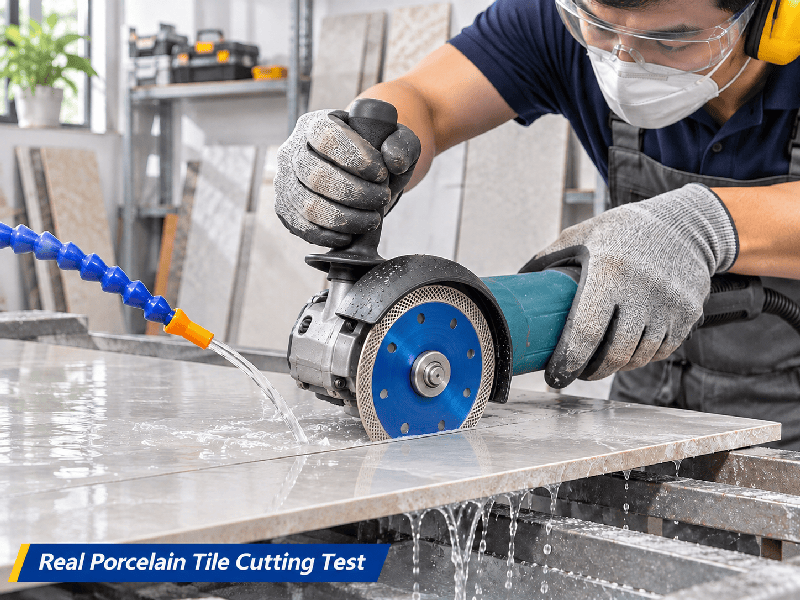
For a meaningful test, photograph the finished edge under good lighting and compare it with the original tile surface.
A clear, close-up image often provides more useful information than a wide shot of the cutting machine.
How to Cut Porcelain Tiles with Less Chipping
If you want a cleaner result, start with the following techniques.
Choose a blade designed for porcelain. Dense porcelain requires a diamond formulation suited to hard, abrasive tile materials.
Support the tile properly. Make sure the workpiece is stable and cannot move unexpectedly during cutting.
Use steady feed pressure. Avoid forcing the blade, especially near the end of the cut.
Check the blade condition. A glazed, damaged, or excessively worn cutting rim may perform poorly even when the blade was originally suitable for the material.
Use the recommended cooling method. For wet-rated equipment and blades, adequate water supply helps control temperature and remove debris.
No diamond blade can guarantee completely chip-free results under every condition. However, the correct combination of blade, equipment, and cutting technique can make a substantial difference.
4. Mesh Turbo Rim Design: What Makes It Different?
The most distinctive feature of this blade is its patterned diamond rim.
Unlike a standard continuous-rim blade, the mesh turbo design uses a repeated geometric structure across the cutting surface.

How Does the Mesh Pattern Affect Cutting?
The shape of a diamond blade’s cutting rim influences the way it contacts the workpiece.
A mesh-style pattern provides a textured cutting surface rather than a completely smooth rim.
The spaces within this pattern can assist with debris movement during cutting, while the diamond bond determines how the abrasive particles are exposed as the rim wears.
This combination is intended to support controlled material removal.
However, the visible pattern alone does not determine the quality of a blade. Two blades with similar-looking mesh rims may behave very differently if they use different diamonds, bond formulations, or manufacturing processes.
Diamond Bond and Material Compatibility
Diamond blades cut by abrasion rather than by using sharp steel teeth.
Industrial diamond particles are held in a metal bond. As the blade works, exposed particles grind away the material.
Over time, the bond wears and allows additional diamond particles to become exposed.
For hard porcelain, the bond must be selected carefully.
If the bond is too hard for the application, new diamonds may not be exposed quickly enough, causing the blade to lose cutting efficiency.
If the bond wears too quickly, the blade may cut aggressively but have a shorter service life.
This is why the best diamond blade for porcelain tiles is not determined by diamond concentration or rim appearance alone.
It depends on how well the complete blade design matches the material.
Does a Thinner Diamond Rim Cut Better?
The featured 125mm Mesh Turbo Diamond Blade has a nominal segment thickness of 1.2mm.
A thinner rim generally removes less material than a wider blade, assuming comparable cutting conditions.
This can be useful when cutting expensive tiles or working in applications where material loss matters.
However, a thinner rim also requires suitable core design, correct installation, and controlled operation.
It should not be assumed that every thin blade will cut faster or last longer than a thicker one.

5. Wet vs. Dry Cutting: Which Method Is Better for Porcelain Tiles?
Another important consideration when choosing a diamond blade for porcelain tile is the cutting method.
Both wet and dry cutting systems exist, but not every blade or machine is suitable for both.
Benefits of Wet Cutting
Wet cutting is commonly preferred for many porcelain and ceramic tile applications.
Water helps cool the cutting rim and remove fine particles produced during the cutting process.
It also helps reduce airborne dust, which is especially important when working with materials containing crystalline silica.
The main benefits of an appropriate wet cutting setup include temperature control, debris removal, and improved dust management.
For the featured Mesh Turbo Diamond Blade series, wet cutting is the recommended method.
Can a 125mm Diamond Blade Be Used for Dry Cutting?
Some diamond cutting discs for angle grinders are specifically designed for dry cutting.
However, this does not mean every 125mm diamond blade is suitable for dry use.
Always check the blade’s operating instructions and the machine manufacturer’s requirements.
If a blade is specified for wet cutting, it should not be used dry unless the manufacturer explicitly approves that application.
Likewise, water should never be introduced to an electrical cutting machine that is not designed for wet operation.
Dust control, eye protection, hearing protection, suitable guarding, and safe workpiece support remain essential regardless of the cutting method.
6. Mesh Turbo vs. Continuous Rim vs. Standard Turbo Diamond Blades
There is no single diamond blade design that is ideal for every tile cutting task.
The most suitable option depends on the material, finish requirements, and cutting equipment.
| Blade Design | Main Characteristics | Typical Considerations |
|---|---|---|
| Mesh Turbo Rim | Patterned diamond cutting surface | Balance of cutting action, debris clearance, and edge quality |
| Continuous Rim | Uninterrupted cutting edge | Often chosen where clean edge finish is a priority |
| Standard Turbo Rim | Grooved or serrated rim profile | Commonly selected for a balance of cutting speed and material removal |
Continuous Rim Diamond Blades
Continuous-rim blades are widely used in tile cutting because their uninterrupted edge can help produce a consistent finish under suitable operating conditions.
They are often selected for applications where minimizing visible chipping is particularly important.
Standard Turbo Diamond Blades
Turbo blades feature a patterned or grooved rim designed to influence cutting action and debris movement.
Depending on their formulation, they may be suitable for tile, stone, masonry, or other materials.
However, not every turbo blade is appropriate for delicate glazed or polished porcelain.
Mesh Turbo Diamond Blades
Mesh turbo blades use a more intricate cutting pattern.
For porcelain and ceramic tile applications, the objective is to provide effective cutting while maintaining acceptable control and edge quality.
When comparing different blade designs, testing them on the same tile with the same machine is more useful than relying only on their appearance.
7. Where Can a 125mm Porcelain Cutting Blade Be Used?
The 125mm size is commonly considered for applications where portability and maneuverability are important.
A suitable 125mm porcelain cutting blade may be used for tasks such as bathroom renovations, kitchen tile installation, flooring work, and tile fitting around fixtures.
Porcelain Floor Tiles
Porcelain floor tiles are typically dense and can be demanding to cut.
Selecting a blade designed for porcelain helps ensure the cutting rim is suited to the material.
Ceramic Wall Tiles
Many ceramic wall tiles are easier to cut than dense porcelain, although glazed surfaces still require care.
A suitable diamond blade for ceramic tile should provide controlled cutting without excessive edge damage.
Bathroom and Kitchen Renovations
Renovation projects often involve cutting tiles to fit around corners, pipes, fittings, and other obstacles.
A compact cutting tool may be useful where space is limited, provided the equipment and blade are appropriate for the task.
Professional Tile Installation
For installers who cut tile regularly, consistency matters.
A blade that performs predictably across repeated cuts can help reduce interruptions and unnecessary finishing work.
8. What Should Contractors and Distributors Consider Before Buying?
For professional users, blade performance should always be evaluated in the context of the intended application.
A blade that works well on one type of porcelain tile may behave differently on another.
For distributors sourcing wholesale diamond tile blades, there are additional factors to consider.
Material Compatibility
First, identify the materials your customers are cutting.
Ordinary ceramic, dense porcelain, textured outdoor tiles, and sintered stone slabs may require different diamond formulations.
It is better to match the blade to the material than to assume one product will perform equally well across every application.
Machine Compatibility
Confirm the blade diameter, arbor size, operating speed, and recommended cutting method.
A 125mm diameter alone does not guarantee that a blade can be safely used on a particular angle grinder or tile saw.
The blade’s maximum permitted operating speed must be compatible with the machine.
Cutting Quality and Blade Life
Both should be considered during testing.
A lower purchase price does not necessarily mean a lower operating cost if the blade wears quickly or produces unacceptable edge damage.
For regular professional use, cost per cut is often a better comparison than unit price.
Sample Testing Before Bulk Orders
When evaluating a new supplier, sample testing is particularly useful.
Ideally, competing blades should be tested on the same material, using the same machine and comparable operating conditions.
Record cutting time, edge quality, blade wear, and the total number of cuts completed.
This provides a more reliable basis for purchasing decisions than short promotional demonstrations alone.
OEM and Wholesale Supply
Johnson Tools supplies diamond cutting and grinding tools for professional applications.
For distributors and tool brands, we can discuss OEM diamond blade manufacturing and supply requirements, including blade specifications, diamond bond selection, branding, packaging, and wholesale orders.
The goal is to select a product that matches the intended application and market rather than offering the same specification for every customer.
9. Frequently Asked Questions About 125mm Mesh Turbo Diamond Blades
What is a mesh turbo diamond blade used for?
A mesh turbo diamond blade features a patterned diamond cutting rim. Depending on its formulation, it can be designed for porcelain, ceramic tile, and other hard materials. Always check the manufacturer’s specified applications.
Is a 125mm diamond blade suitable for porcelain tiles?
Yes. A 125mm diamond blade for porcelain tile can be suitable when its diamond bond and cutting rim are designed for the material, and the blade is used with compatible equipment.
How can I cut porcelain tile without chipping?
Use a porcelain-rated diamond blade, support the tile securely, maintain steady cutting pressure, and follow the recommended cooling method. For important visible cuts, make a test cut first.
Is a mesh turbo blade better than a continuous rim blade?
Not necessarily. Both designs can work well on porcelain when correctly specified. The best choice depends on the tile, equipment, cutting speed, and edge finish requirements.
Can I use a 5 inch diamond blade on an angle grinder?
Only if the blade is specifically approved for the intended equipment and cutting method. Check arbor compatibility, maximum operating speed, guards, and the machine manufacturer’s instructions.
Does wet cutting help extend diamond blade life?
Wet cutting can help manage heat and remove cutting debris, potentially reducing abnormal wear under suitable conditions. Actual blade life still depends on the material, bond formulation, and operating technique.
10. Final Thoughts: Is the 125mm Mesh Turbo Diamond Blade Worth Considering?
The 125mm Mesh Turbo Diamond Blade is an option worth evaluating for porcelain and ceramic tile cutting applications.
Its patterned diamond rim and relatively thin cutting profile are designed to support controlled material removal. However, the final cutting result depends on more than the blade’s appearance.
Tile hardness, diamond bond, machine condition, cutting pressure, and cooling all influence performance.
A cutting video can help demonstrate how a blade works, but careful examination of the finished edge and repeated cutting tests provide a more complete picture.
For contractors, the priority is finding a blade that delivers the required finish at a practical cutting speed.
For distributors, the additional challenge is finding a specification that can provide consistent results across repeat orders.
If you’re evaluating a new porcelain cutting blade, start with sample testing on the materials your customers actually use.
We can offer free sample testing.
Looking for a Reliable 125mm Mesh Turbo Diamond Blade Supplier?
Johnson Tools supplies diamond cutting tools for porcelain, ceramic, stone, and construction applications.
We support product selection, sample testing, wholesale supply, and OEM/ODM customization.
Whether you’re sourcing a 5 inch diamond blade for porcelain tile or developing a customized diamond blade range for your market, contact us to discuss your requirements.
Johnson Tools
Website: www.johnsontoolscn.com
Email: sales@johnsontoolscn.com
WhatsApp: +86 18936085316
Contact us for product specifications, samples, wholesale quotations, and OEM/ODM solutions.