Skip to main content Skip to footer
When drilling glass, cutting holes in ceramic tiles, or engraving detailed patterns into stone, choosing the right diamond tool is essential for achieving precise results and reducing material damage.
Electroplated diamond drill bits, diamond hole saws, and diamond grinding burrs are widely used for processing hard and brittle materials such as glass, marble, ceramic, and selected natural stones.
Unlike conventional cutting tools, electroplated diamond tools use diamond abrasive particles secured to a metal body through a nickel electroplating process. This creates an exposed abrasive surface suitable for controlled drilling, grinding, carving, and detail finishing.
In Electroplated Diamond Tools Buying Guide Part 1, we introduced electroplated diamond saw blades, grinding wheels, and stone profile wheels.
In Part 2, we focus on two additional product categories:
- Electroplated Diamond Drill Bits and Hole Saws for drilling glass, ceramic tiles, marble, and other compatible materials.
- Electroplated Diamond Burrs and Grinding Bits for stone carving, glass engraving, edge finishing, and precision grinding.
This guide explains their applications, available specifications, diamond grit options, and how to choose suitable tools for professional use.
1. What Are Electroplated Diamond Drill Bits and Burrs?
Electroplated diamond drill bits and burrs are abrasive tools manufactured by attaching diamond particles to a metal base using an electroplated nickel bonding layer.
The diamond particles form the working surface that removes material through abrasion.
Most conventional electroplated diamond tools have a single layer of diamond abrasive particles.
This design offers several advantages:
- High diamond grain exposure for efficient material removal.
- Precise abrasive action for detailed drilling and grinding.
- Flexible manufacturing of different shapes and sizes.
- Compatibility with many specialized glass, stone, and ceramic processing applications.
However, because standard electroplated tools generally contain only one abrasive layer, their working performance gradually decreases as the diamond particles wear or detach.
For this reason, electroplated diamond tools should be selected according to the workpiece material, operating conditions, and required processing quality.
2. Main Types of Electroplated Diamond Drilling and Grinding Tools
Electroplated diamond drilling and grinding tools are available in different configurations.
The two main categories discussed in this guide are diamond drill bits and hole saws, and diamond grinding bits and burrs.
2.1 Electroplated Diamond Drill Bits and Hole Saws
Electroplated diamond drill bits are designed for creating holes in suitable hard and brittle materials.
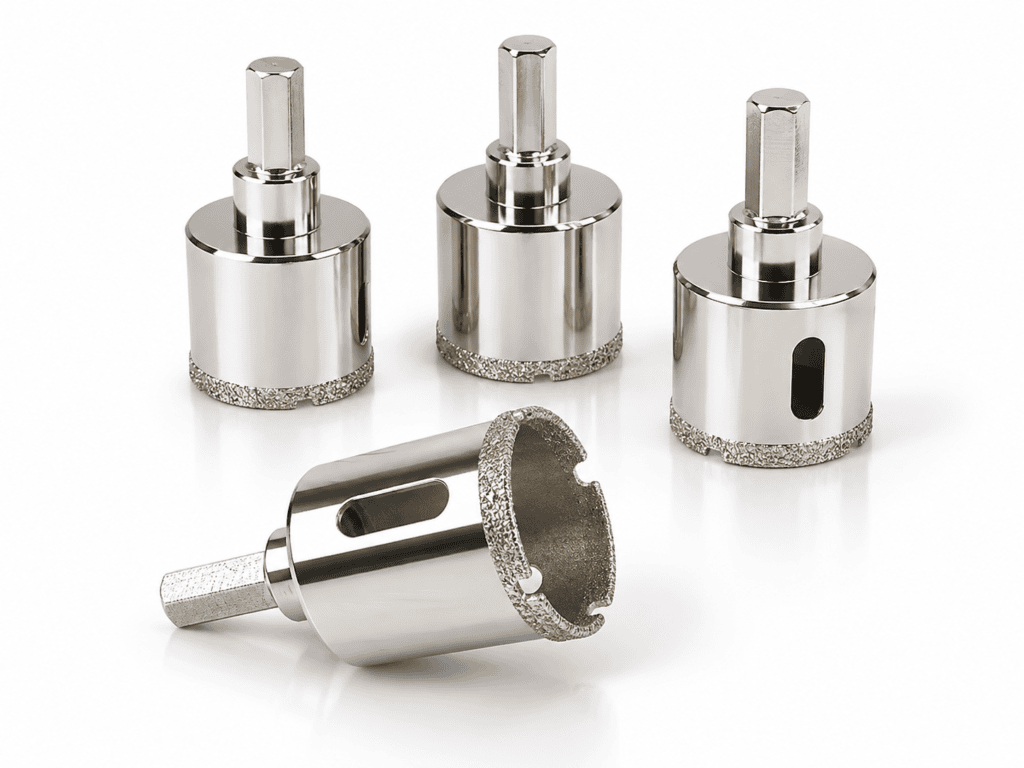
Many electroplated drilling tools use a hollow cylindrical cutting head, commonly known as a diamond hole saw.
Instead of removing the entire hole area like a conventional twist drill, a diamond hole saw grinds through the material around the circumference of the hole.
This structure can reduce the amount of material that needs to be removed when drilling larger openings.
Electroplated diamond hole saws are commonly used for:
- Drilling glass panels and glass products.
- Making holes in ceramic tiles.
- Drilling marble and decorative stone.
- Processing certain ceramic products.
- Creating openings in other compatible brittle materials.

Common Electroplated Diamond Hole Saw Specifications
| Specification | Available Options |
|---|---|
| Product Type | Electroplated Diamond Drill Bits / Diamond Hole Saws |
| Diameter Range | 5–170 mm |
| Shank Type | Round Shank, Hex Shank |
| Threaded Connection | M14 and Other Custom Options |
| Tool Design | Hollow Diamond Hole Saw / Cup-Type Drill |
| Applications | Glass, Marble, Ceramic, Compatible Tiles |
| Packaging | White Box, Plastic Tube |
| Customization | Diameter, Connection, Packaging |
The actual size, connection, and working configuration should be confirmed according to the drilling machine and target material.
Round Shank vs Hex Shank vs M14 Diamond Hole Saws
Different machines require different mounting configurations.
Round Shank Diamond Drill Bits
Round shank diamond drill bits are designed for compatible drill chucks and are commonly used with suitable electric drilling equipment.
Hex Shank Diamond Drill Bits
Hex shank designs can provide convenient mounting in compatible drill chucks and certain quick-change systems.
M14 Diamond Hole Saws
M14 threaded diamond hole saws are intended for compatible threaded spindles and approved mounting systems.
Users should always verify that the machine, tool connection, working speed, and drilling method are compatible before operation.
2.2 Electroplated Diamond Grinding Bits and Burrs
Electroplated diamond burrs, also called diamond grinding bits, are small abrasive tools designed for detailed material removal, engraving, grinding, and shaping.
These tools are typically mounted on suitable rotary tools, die grinders, or specialized grinding equipment.
Unlike diamond hole saws, which are primarily designed for drilling holes, diamond burrs are used to process localized surfaces and complicated shapes.
Typical applications include:
- Stone carving and engraving.
- Glass surface decoration.
- Ceramic edge finishing.
- Small-area grinding.
- Detailed shape correction.
- Processing grooves and curved surfaces.

Common Electroplated Diamond Burr Specifications
| Specification | Available Options |
|---|---|
| Product Type | Electroplated Diamond Grinding Bits / Diamond Burrs |
| Working Diameter | 6, 8, 10, 12 mm |
| Shank Diameter | 3 mm, 6 mm |
| Overall Length | 45 mm, 60 mm |
| Diamond Grit | 60, 80, 100, 150 Mesh |
| Main Applications | Stone, Glass, Ceramic Grinding and Carving |
| Packaging | Plastic Bag, Plastic Box |
| Supply Options | Individual Burrs or Sets |
These dimensions represent common product configurations. Specific shapes and combinations may vary according to customer requirements.
Common Diamond Burr Shapes and Their Uses
Different diamond burr shapes are designed for different processing tasks.
Cylindrical Diamond Burrs
Cylindrical burrs are commonly used for grinding flat areas, straight edges, and internal surfaces.
They can also be useful for enlarging or adjusting certain openings when the tool is suitable for the application.
Ball-Shaped Diamond Burrs
Ball-shaped diamond grinding bits are suitable for curved surfaces, rounded recesses, and detailed engraving.
They are often selected for decorative glasswork and stone carving applications.
Conical Diamond Burrs
Conical burrs are useful for tapered surfaces, narrow areas, and detailed shaping.
They can help process corners, grooves, and certain intricate contours.
Pointed Diamond Burrs
Pointed designs can be used for fine engraving details, narrow grooves, and localized grinding.
The appropriate shape depends on the design of the workpiece, material hardness, required finish, and available machine.
For OEM buyers, custom diamond burr shapes can be reviewed according to technical drawings or samples.
3. Applications of Electroplated Diamond Drill Bits
Different drilling materials require different cutting conditions.
An electroplated diamond hole saw suitable for glass may not provide the same performance when drilling dense porcelain or highly abrasive stone.
Understanding the material is therefore one of the most important steps in selecting the right diamond drill bit.
3.1 Diamond Hole Saws for Glass Drilling
Glass is hard and brittle, making it vulnerable to cracking or chipping when excessive pressure is applied.
A properly selected diamond hole saw for glass removes material through grinding rather than conventional sharp-edge cutting.
This makes diamond abrasive drilling suitable for many glass processing applications.
Typical uses include:
- Drilling glass panels.
- Creating holes in glass bottles and decorative products.
- Glass craft processing.
- Manufacturing glass components with drilled openings.
Tips for Drilling Glass with Diamond Hole Saws
For suitable glass materials and approved drilling tools:
- Secure the glass firmly on a stable support.
- Select the correct diamond hole saw diameter.
- Use the recommended drilling speed.
- Apply water cooling when required by the tool and machine.
- Maintain controlled pressure and avoid excessive force.
- Reduce feed pressure as the drill approaches the exit surface.
For better hole quality, proper workpiece support is particularly important.
Important: Ordinary glass drilling techniques must not be assumed suitable for tempered or safety glass. Many types of tempered glass cannot be drilled after tempering without shattering.
3.2 Diamond Drill Bits for Ceramic Tile and Porcelain
Ceramic tiles are widely used in bathrooms, kitchens, and construction projects.
Drilling holes in tile requires suitable tools because the hard glazed surface and brittle body can make conventional drilling difficult.

Electroplated diamond drill bits for ceramic tile can be useful for drilling compatible ceramic materials under appropriate conditions.
Common applications include:
- Bathroom tile installation.
- Kitchen wall tile drilling.
- Drilling holes for plumbing fixtures.
- Decorative tile processing.
- Ceramic product manufacturing.
Ceramic Tile vs Porcelain Tile
Not all tiles have the same characteristics.
Glazed Ceramic Tile
Glazed ceramic tiles generally have a ceramic body with a decorative or protective glazed surface.
Depending on their hardness and structure, some can be drilled using suitable electroplated diamond hole saws.
Porcelain Tile
Porcelain tiles typically have a dense, low-absorption body and can be more demanding to drill.
For hard porcelain tile, vacuum brazed or other specialized diamond drilling tools may offer better performance, depending on the application.
Therefore, buyers should not assume that every electroplated diamond hole saw is suitable for continuous drilling of dense porcelain.
Before placing bulk orders, professional users should test the selected tool on the actual tile material.
3.3 Diamond Hole Saws for Marble and Natural Stone
Marble is widely used for countertops, wall decoration, architectural elements, and interior stone products.
A suitable diamond hole saw for marble can be used to create openings for fittings, decorative components, and other installations.
Applications may include:
- Marble slab drilling.
- Stone countertop fabrication.
- Decorative stone product manufacturing.
- Drilling holes in natural stone accessories.
- Customized stone processing.
When drilling marble, users should consider material thickness, internal cracks, machine stability, and cooling requirements.
For granite and other harder natural stones, the tool design and bonding method should be selected according to the stone’s abrasiveness and the required production volume.
4. Applications of Electroplated Diamond Burrs and Grinding Bits
While diamond hole saws are primarily used for drilling, electroplated diamond grinding bits are designed for detailed grinding, engraving, shaping, and localized material removal.
They are especially useful when larger grinding wheels cannot reach narrow or complicated areas.
4.1 Diamond Burrs for Stone Carving
Diamond carving burrs for stone are used to shape small details and decorative features on suitable natural and engineered stone materials.
Typical applications include:
- Marble carving.
- Decorative stone engraving.
- Stone sculpture detail work.
- Small groove grinding.
- Edge correction and shape adjustment.
Different burr shapes are selected according to the required carving geometry.
For example, a pointed burr can be suitable for narrow details, while a cylindrical burr may be more appropriate for processing straight areas or grooves.
Stone hardness and abrasiveness can significantly affect burr performance and service life.

4.2 Diamond Grinding Bits for Glass Engraving
Glass engraving requires accurate control because the material is brittle and can be damaged by excessive pressure or vibration.
Diamond burrs for glass engraving can be used to create decorative patterns, shallow grooves, and localized surface textures.
Applications include:
- Decorative glass engraving.
- Glass craft production.
- Small detail grinding.
- Surface texture processing.
- Edge and corner correction.
Finer diamond grit sizes may be selected when a more controlled surface finish is required.
However, the final appearance also depends on the burr shape, operating speed, contact pressure, and engraving technique.
4.3 Diamond Burrs for Ceramic Grinding and Edge Finishing
Ceramic products may require localized grinding after forming, cutting, or drilling.
Small diamond burrs can be useful for reaching narrow areas and processing detailed edges.
Typical tasks include:
- Ceramic edge correction.
- Small hole enlargement.
- Localized chamfering.
- Grinding curved sections.
- Removing minor surface irregularities.
For particularly hard technical ceramics or highly dense porcelain, a specialized diamond tool may be required.
5. How to Choose the Right Electroplated Diamond Drill Bits and Burrs
Choosing the correct electroplated diamond tool depends on the material, processing method, required accuracy, and machine configuration.
5.1 Choose the Right Tool for Your Material
Different workpiece materials require different tool characteristics.
| Material | Recommended Tool Category | Main Considerations |
|---|---|---|
| Glass | Diamond Hole Saw / Diamond Burr | Controlled pressure, cooling, edge quality |
| Glazed Ceramic Tile | Compatible Diamond Hole Saw | Glaze hardness, tile structure, chipping |
| Porcelain Tile | Specialized Diamond Hole Saw | High density, wear resistance, drilling efficiency |
| Marble | Diamond Hole Saw / Diamond Burr | Stone structure, finish requirements |
| Granite | Application-Specific Diamond Tools | Abrasiveness, tool wear, production volume |
| Decorative Stone | Diamond Burrs | Shape, grit size, detail accuracy |
This table provides general selection guidance rather than a guarantee of suitability for every material.
Professional buyers should confirm the actual tool design and conduct sample testing when necessary.

5.2 Select the Correct Diameter and Shank Type
For electroplated diamond drill bits, diameter determines the size of the hole.
The available product range discussed in this guide covers common diameters from 5 mm to 170 mm.
For diamond grinding burrs, the working diameter affects accessibility and the amount of material removed.
Common working diameters include:
- 6 mm.
- 8 mm.
- 10 mm.
- 12 mm.
Common shank diameters include 3 mm and 6 mm.
Before purchasing, verify that the tool shank or thread matches the intended machine.
The tool’s maximum rated RPM must also be compatible with the equipment.
5.3 Understanding Diamond Grit Size: 60, 80, 100 and 150 Mesh
Diamond grit size plays an important role in grinding performance and surface quality.
In general, lower mesh numbers indicate coarser abrasive particles, while higher mesh numbers indicate finer particles.
Common electroplated diamond burr grit options include:
| Diamond Grit | Relative Grade | Typical Application |
|---|---|---|
| 60 Mesh | Coarse | Aggressive grinding and initial shaping |
| 80 Mesh | Medium-Coarse | General material removal |
| 100 Mesh | Medium | Controlled grinding and detail work |
| 150 Mesh | Fine | Finer grinding and surface preparation |
These applications are general guidelines. The actual abrasive grading system and results should be confirmed according to the specific product.
Coarse vs Fine Diamond Burrs
Coarse Diamond Burrs
Coarse diamond burrs are typically selected when faster material removal is more important than obtaining a fine surface.
Fine Diamond Burrs
Finer diamond grinding bits can be useful for controlled detail processing and improving the intermediate surface finish.
For certain precision applications, several grit stages may be required.
A 150-mesh diamond burr should not be considered a substitute for final polishing when a high-gloss finish is required.
5.4 Choose the Right Diamond Burr Shape
The working shape directly affects how the diamond burr contacts the material.
For example:
- Cylindrical burrs can be selected for flat areas and straight-sided surfaces.
- Ball burrs can be selected for rounded details and concave areas.
- Conical burrs can be used for tapered surfaces and narrow grooves.
- Pointed burrs can be selected for fine engraving and intricate patterns.
The shape should be chosen according to the workpiece geometry rather than simply selecting the largest or most aggressive burr.
6. Electroplated vs Vacuum Brazed Diamond Drill Bits: What’s the Difference?
Electroplated and vacuum brazed diamond drill bits both use diamond abrasives attached to a metal tool body.
However, their bonding technologies are different.
Electroplated diamond drill bits generally use nickel electroplating to secure diamond particles.
Vacuum brazed diamond drill bits use a brazing alloy to create a metallurgical bond between the abrasive particles and the tool body.
These differences can influence diamond retention, cutting behavior, and tool design.
| Feature | Electroplated Diamond Drill Bits | Vacuum Brazed Diamond Drill Bits |
|---|---|---|
| Bonding Technology | Nickel Electroplating | Vacuum Brazing |
| Diamond Structure | Usually Single Layer | Usually Single Layer |
| Abrasive Exposure | High | High |
| Typical Advantage | Controlled Abrasive Drilling | Strong Diamond Attachment |
| Suitable Materials | Selected Glass, Ceramic, Stone | Selected Tile, Stone and Other Compatible Materials |
| Tool Life | Depends on Application | Depends on Application |
| Main Selection Factors | Material, Finish, Speed, Cooling | Material, Cutting Performance, Cooling |
For example, an electroplated diamond hole saw may be appropriate for certain glass drilling applications.
For demanding porcelain tile drilling, a properly designed vacuum brazed diamond hole saw may offer advantages.
However, neither bonding method guarantees superior performance in every application.
The best choice depends on the diamond specification, tool construction, machine, workpiece, and operating conditions.
7. Tips for Better Drilling and Grinding Performance
Correct operation is essential for achieving consistent performance from electroplated diamond drill bits and grinding burrs.
7.1 Use the Correct Machine and Tool Connection
Select a machine suitable for the drilling or grinding application.
Verify the shank size, thread type, operating speed, and tool specifications.
Never exceed the maximum rated RPM of the diamond tool.
7.2 Apply Appropriate Pressure
Excessive pressure can increase heat, accelerate abrasive wear, or damage brittle materials.
Apply controlled pressure and allow the diamond abrasives to perform the cutting or grinding action.
For glass and fragile ceramic products, secure the workpiece and avoid sudden force.
7.3 Use Cooling When Required
Water cooling is commonly used in suitable glass, tile, and stone drilling operations.
It can help reduce heat and remove grinding debris.
However, cooling requirements depend on the specific diamond tool and machine.
Only use wet drilling with equipment approved for wet operation and appropriate electrical protection.
7.4 Prevent Overheating
Excessive heat may reduce tool performance and contribute to premature diamond wear.
Select an appropriate operating speed and avoid prolonged heavy contact.
For detailed grinding, allow the abrasive surface to work without unnecessary pressure.
7.5 Inspect Tool Wear Regularly
Check the condition of the diamond coating, tool body, and mounting connection.
Replace tools showing excessive wear, damage, or unsafe operating conditions.
For production environments, evaluating performance across several samples can help determine suitable replacement intervals.
8. OEM Electroplated Diamond Drill Bits and Burrs for Wholesale Buyers
For tool distributors, importers, stone processing businesses, and industrial buyers, custom specifications are often an important part of diamond tool procurement.
At Johnson Tools, we provide electroplated diamond tool supply and customization solutions for different professional applications.
Our electroplated diamond product range includes diamond drill bits, diamond hole saws, and diamond grinding burrs.
8.1 Custom Diamond Drill Bit Sizes
Different applications require different hole diameters and mounting configurations.
We can review custom diamond drill bit requirements according to customer drawings, product specifications, and target materials.
Common customization parameters include:
- Hole saw diameter.
- Shank or thread connection.
- Tool structure.
- Application material.
- Packaging requirements.
8.2 Custom Diamond Burr Shapes and Grit Sizes
Different engraving and grinding applications require different abrasive shapes and diamond grit sizes.
For OEM diamond grinding bits, buyers can provide the required working diameter, shank size, overall length, grinding shape, and grit specifications.
Our common diamond burr range includes 60, 80, 100, and 150-mesh options.
Custom requirements can be reviewed according to manufacturing feasibility.
8.3 Individual Products and Diamond Burr Sets
Electroplated diamond burrs can be supplied individually or in assorted sets, depending on the confirmed product range.
For distributors and private-label buyers, different product combinations may be considered to suit specific markets.
8.4 OEM Branding and Custom Packaging
Packaging can play an important role in retail distribution and wholesale product presentation.
Depending on the product and order requirements, available packaging formats may include:
- White boxes.
- Plastic tubes.
- Plastic bags.
- Plastic storage boxes.
- Customized packaging options.
Private-label branding requirements can also be discussed during the quotation process.
8.5 What Information Should Buyers Provide for a Quotation?
| Product Type | Required Information |
|---|---|
| Electroplated Diamond Drill Bits | Diameter, Shank Type, Drilling Material |
| Diamond Hole Saws | Diameter, Connection, Drilling Depth, Material |
| Diamond Grinding Burrs | Working Diameter, Shank, Length, Shape, Grit Size |
| Diamond Burr Sets | Burr Shapes, Quantities, Grit Options, Packaging |
| Custom Diamond Tools | Technical Drawing, Sample, Application, Estimated Quantity |
Providing complete information helps manufacturers recommend appropriate products and prepare accurate quotations.
Looking for an Electroplated Diamond Tool Supplier?
Whether you are sourcing wholesale diamond hole saws, electroplated diamond drill bits, or custom diamond burr sets, choosing the correct specifications is essential for reliable product performance.
Contact Johnson Tools with your application details, drawings, required sizes, and estimated order quantity to discuss suitable OEM electroplated diamond tool solutions.
9. Frequently Asked Questions About Electroplated Diamond Drill Bits and Burrs
Q1. What materials can electroplated diamond drill bits cut?
Electroplated diamond drill bits can be used for drilling selected hard and brittle materials, including ordinary glass, marble, some ceramic tiles, and other compatible materials.
The actual suitability depends on the tool design, diamond specification, and operating conditions.
Q2. Can electroplated diamond hole saws drill porcelain tiles?
Some electroplated diamond hole saws may be capable of drilling certain porcelain tiles.
However, dense porcelain can be highly demanding, and tool wear may be significant.
For frequent drilling of hard porcelain, specialized vacuum brazed or other application-specific diamond drill bits may be more suitable.
Q3. Do diamond hole saws need water?
Many diamond hole saws designed for glass and ceramic drilling benefit from water cooling.
Water can help control heat and remove abrasive debris.
However, users must follow the specific manufacturer’s instructions because some diamond drilling products are designed for dry operation.
Q4. What is the difference between diamond drill bits and diamond burrs?
Diamond drill bits and hole saws are mainly used for creating holes.
Diamond burrs are primarily designed for localized grinding, carving, shaping, and engraving.
Although both use diamond abrasives, their working geometries and intended applications are different.
Q5. What diamond grit size is best for stone carving?
The appropriate grit depends on the stone, carving stage, and desired surface finish.
Coarse grits such as 60 mesh may be useful for initial material removal.
Finer grits such as 100 or 150 mesh can be considered for more controlled detail grinding.
For highly polished surfaces, additional finishing steps may be necessary.
Q6. How long do electroplated diamond burrs last?
Their service life depends on diamond quality, nickel bond performance, material abrasiveness, tool speed, pressure, cooling, and operating technique.
Because conventional electroplated diamond burrs generally contain a single abrasive layer, their effectiveness decreases as the exposed diamond particles wear away.
Q7. Can electroplated diamond drill bits and burrs be customized?
Yes. Custom electroplated diamond drill bits and burrs can be developed or supplied according to confirmed manufacturing capabilities.
Customization requirements may include diameter, tool length, shank connection, abrasive shape, diamond grit, and packaging.
Providing technical drawings or physical samples helps ensure accurate product specifications.
10. Conclusion: Choosing the Right Diamond Tools for Drilling and Detail Grinding
Electroplated diamond drill bits, diamond hole saws, and diamond burrs provide versatile solutions for drilling, carving, grinding, and detailed processing of suitable hard and brittle materials.
For glass, ceramic, tile, and stone applications, selecting the correct diamond tool requires careful consideration of the workpiece, tool diameter, shank type, abrasive grit, machine compatibility, and processing method.
Electroplated Diamond Drill Bits and Hole Saws are primarily designed for creating holes in compatible materials.
Electroplated Diamond Burrs and Grinding Bits are better suited for carving, local grinding, engraving, and precision shaping.
For wholesalers, distributors, and OEM buyers, customized specifications and suitable packaging can provide additional flexibility for different market requirements.
Contact our team to discuss diamond drill bits, diamond hole saws, grinding burrs, and customized product requirements.
Explore More: Electroplated Diamond Tools Buying Guide Part 1 – Blades, Grinding Wheels & Profile Wheels.