Skip to main content Skip to footer
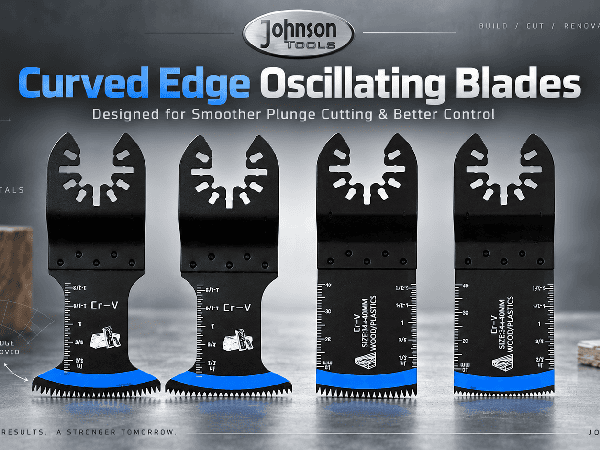
In today’s construction, renovation, flooring, cabinetry, and woodworking industries, professionals expect more from their power tool accessories. A blade is no longer judged only by whether it can complete a cut. Contractors and distributors increasingly care about cutting speed, positioning accuracy, vibration, blade life, finish quality, and compatibility with different oscillating multi-tools.
This is especially true for deep plunge cutting, where conventional blade geometry can directly affect productivity.
Traditional flat-edge oscillating tool blades remain widely used, but their straight cutting edge can create limitations when entering material deeply or starting a precise plunge cut. The entire cutting edge may contact the workpiece almost simultaneously, which can increase vibration, make the blade harder to position, and generate unnecessary friction.
This is why curved edge oscillating blades, also called arc edge oscillating saw blades, are becoming increasingly attractive to professional users, wholesalers, importers, and private-label tool brands.
As a professional diamond tool and power tool accessory manufacturer, Johnson Tools develops oscillating multi-tool accessories with a strong focus on cutting efficiency, practical jobsite performance, manufacturing consistency, and OEM/ODM flexibility.
For distributors looking to upgrade their multi-tool accessory range, curved-edge blade technology offers both a technical advantage and a valuable product differentiation opportunity.

Why Traditional Flat Multi-Tool Blades Can Limit Cutting Performance
Straight cutting edges are simple, familiar, and suitable for many general cutting applications. However, when users need controlled plunge cuts, longer reach, or repeated professional use, several common problems can become more noticeable.
1. Initial Blade Skidding
During a plunge cut, a traditional straight blade may bring multiple teeth into contact with the surface at almost the same moment.
This can make the initial bite more aggressive and less controlled.
Instead of immediately penetrating the intended cutting line, the blade may move slightly across the surface before establishing a stable cutting path. This type of blade skidding can be particularly frustrating when working near visible surfaces, finished panels, cabinets, flooring, or trim.
For professional installers, even a small positioning error can mean additional finishing work.
2. Excessive Vibration and Operator Fatigue
Oscillating tools already operate through rapid side-to-side movement. When too much of the cutting edge contacts the workpiece at once, resistance can increase.
That resistance is transferred back through the blade and tool.
Over longer working periods, excessive vibration may:
- Reduce cutting control
- Increase operator fatigue
- Make precision cuts more difficult
- Put additional stress on the blade
- Reduce overall cutting efficiency
For contractors performing repeated plunge cuts throughout the day, cutting smoothness matters almost as much as raw cutting speed.
3. Increased Friction and Heat
Another challenge with some traditional flat multi-tool blades is heat generation.
When the blade remains under heavy contact and chips cannot evacuate efficiently, friction increases. In wood applications, excessive heat can contribute to darkened or burned cutting surfaces.
A well-designed blade should therefore do more than cut quickly. It should also help manage chip evacuation and heat throughout the cut.
This is particularly important for users looking for consistent, cleaner and more burn-free wood cutting performance.

The Johnson Tools Engineering Advantage: Curved Edge Geometry
The key difference of a curved edge oscillating blade is immediately visible in its cutting profile.
Instead of using a completely straight cutting line, the blade features a carefully designed convex cutting arc.
This geometry changes the way the teeth enter and travel through the material.
The result is not simply a different-looking blade. The curved profile creates a different cutting behavior.
Progressive Tooth Engagement
One of the biggest advantages of the arc design is progressive tooth engagement.
Rather than forcing the complete cutting edge into the material simultaneously, the curved profile allows the teeth to enter the workpiece progressively.
This creates several practical benefits.
The blade can establish its cutting position more smoothly, reducing the tendency to skid during the start of a plunge cut.
Once cutting begins, the blade gradually engages a larger portion of the tooth line as it penetrates deeper.
For the user, this can mean:
- Easier blade positioning
- Better plunge-cut control
- Reduced initial impact
- Smoother cutting action
- More efficient material penetration
For professional applications where accuracy matters, progressive engagement can make the tool feel noticeably more controlled.
Improved Chip Removal and Heat Management
Cutting performance is strongly related to what happens to the chips after each tooth removes material.
If sawdust or debris remains trapped around the teeth, cutting resistance and temperature can increase.
The arc-shaped cutting edge helps create a more dynamic cutting path during oscillation, allowing cutting debris to move away from the active tooth area more efficiently.
Better chip evacuation can help reduce unnecessary heat buildup and support longer blade life.
This is especially important for wholesalers sourcing oscillating multi-tool blades for professional contractors, where repeat-use durability is often a stronger selling point than initial purchase price alone.
Cleaner Cutting With Less Effort
Professional users do not simply want faster blades. They want predictable blades.
A well-engineered arc edge oscillating saw blade helps the user guide the tool into the workpiece rather than forcing the complete cutting edge through the material.
The progressive action can reduce the amount of pressure required during cutting.
Depending on the blade material and tooth configuration, this can help deliver:
- Cleaner plunge cuts
- Reduced surface tearing
- Better cutting control
- Smoother operation
- Faster material removal
- Less operator fatigue
For woodworking, flooring installation, cabinet fitting, renovation, and interior construction, these small improvements translate into meaningful productivity gains across a full working day.
Technical Highlights and Application Options
Different applications require different blade constructions.
Johnson Tools can supply curved edge oscillating blades in a variety of materials, tooth patterns, coatings, dimensions, and connection systems to support different professional markets.

Japanese Tooth Oscillating Saw Blades for Fast Wood Cutting
For fast cutting in softwood, hardwood, plywood, MDF, and other wood-based materials, a Japanese tooth oscillating saw blade can provide aggressive and efficient material removal.
Japanese-style tooth geometry is designed for sharp cutting performance and fast chip evacuation.
Combined with a curved blade profile, it is particularly suitable for:
- Wood plunge cutting
- Cabinet installation
- Flooring work
- Door frame trimming
- Furniture modification
- Interior renovation
For distributors serving carpentry and woodworking markets, this is an important high-volume blade category.
Bi-Metal Wood With Nails Multi Tool Blades
Not every jobsite cut involves clean timber.
Renovation professionals frequently encounter old screws, small nails, staples, metal fasteners, and mixed materials hidden inside wood structures.
For these situations, bi-metal wood-with-nails multi-tool blades provide a more durable solution.
Bi-metal construction combines the flexibility of the blade body with a harder, wear-resistant cutting edge.
This allows the blade to handle demanding applications such as:
- Wood with embedded nails
- Drywall and timber combinations
- Remodeling work
- Door and window installation
- Old building renovation
- Mixed-material demolition cuts
For B2B distributors, offering both wood-only and wood-with-metal blade options creates a clearer product ladder and enables better end-user segmentation.
Bimetal and Titanium-Coated Oscillating Blades
Professional users are increasingly willing to pay more for blades that last longer.
This is where bimetal and titanium-coated oscillating blades can create additional value.
Depending on the blade design, titanium-based surface treatments can help improve wear resistance and heat resistance while enhancing the product’s premium visual appearance.
Titanium coated oscillating multi-tool blades are particularly attractive for distributors building a mid-range or premium accessory line.
The commercial benefit is important.
Instead of competing only on the lowest possible blade price, importers can create multiple product levels:
Standard blade
Professional bi-metal blade
Premium coated blade
This provides more opportunities for margin differentiation within the same accessory category.
68mm Cutting Depth and Extended Reach Oscillating Saw Blades
Standard oscillating blades are ideal for many everyday jobs, but some applications require deeper penetration.
This is why Johnson Tools also supports 68mm cutting depth / extended reach oscillating saw blades for specialized applications.
The extra blade length can help users reach deeper areas when cutting:
- Wall structures
- Timber framing
- Deep grooves
- Pipes and plastic components
- Recessed construction materials
- Difficult-to-access interior areas
For contractors, an extended blade can solve applications that standard blade lengths simply cannot reach.
For wholesalers, adding extended reach oscillating saw blades expands the product range beyond basic replacement blades and gives professional users a strong reason to purchase specialized accessories.
Universal Quick Release Oscillating Saw Blades
Compatibility is one of the most important concerns for both end users and distributors.
Professional tool users may own multiple brands of oscillating tools, while distributors often sell accessories alongside several different power tool brands.
For this reason, Johnson Tools offers universal quick release oscillating saw blades designed to fit a wide range of popular oscillating multi-tool systems.
A universal interface offers several commercial advantages.
Wholesalers can reduce excessive SKU complexity.
Retailers can stock one blade for multiple tool platforms.
End users can purchase accessories with greater confidence.
OEM customers can also develop a broader accessory program without creating a separate blade model for every tool brand.
When developing a private-label product range, Johnson Tools can work with customers to select the appropriate interface according to the intended market and compatible tool systems.
Applications Across Professional Trades
Because oscillating tools are highly versatile, curved blades can serve a wide range of professional users.
Typical applications include:
- Carpentry
- Cabinet installation
- Flooring installation
- Interior renovation
- Remodeling
- Door frame trimming
- Drywall installation
- Furniture work
- Plumbing access work
- Building maintenance
- General construction
Material capability depends on the blade material and tooth configuration.
Typical cutting materials may include:
- Softwood
- Hardwood
- Plywood
- MDF
- Laminated panels
- Plastic
- PVC
- Drywall
- Wood with nails
- Thin metal materials
This makes oscillating multi-tool blades one of the most versatile accessory categories for professional power tool distributors.

Why B2B Buyers Choose Johnson Tools
For wholesalers and distributors, blade performance is only one part of the purchasing decision.
Successful sourcing also depends on cost control, product consistency, customization capability, delivery reliability, and the ability to build a differentiated local brand.
Johnson Tools approaches the business from a manufacturer’s perspective.
Factory-Direct Wholesale Supply
Working directly with a professional manufacturer can help importers build a more competitive pricing structure.
Johnson Tools has extensive experience supplying tools and accessories to international markets and supports wholesale oscillating multitool saw blades for distributors, importers, tool brands, and industrial suppliers.
Factory-direct cooperation can help B2B customers:
- Optimize sourcing costs
- Improve wholesale margins
- Build competitive retail pricing
- Develop exclusive product configurations
- Consolidate multiple accessory specifications
- Support long-term product programs
For many distributors, the objective is not simply to purchase the cheapest blade.
The more important goal is achieving the right balance between purchasing cost, quality consistency, retail positioning, and margin.
OEM/ODM Customized Oscillating Blades
Different markets require different products.
A European professional tool distributor may have very different requirements from a North American hardware brand or a South American wholesaler.
Johnson Tools supports OEM/ODM customized oscillating blades according to customer positioning and target market requirements.
Customization options can include:
- Blade dimensions
- Cutting depth
- Tooth geometry
- Tooth pitch
- Blade body shape
- Bi-metal construction
- Surface coating
- Printed branding
- Laser marking
- Private labels
- Color packaging
- Blister packaging
- Retail sets
- Bulk industrial packaging
This allows customers to build their own product identity instead of simply reselling another generic accessory.
For established distributors, customization can also help reduce direct price comparison in the market.

Build a More Profitable Product Range
One of the greatest advantages of oscillating tool accessories is the opportunity to create product families.
Instead of selling only one universal blade, distributors can develop complete ranges around specific applications.
For example:
Wood Cutting Series
Japanese tooth blades for fast and clean timber cutting.
Wood With Nails Series
Bi-metal blades for renovation and demolition work.
Premium Coated Series
Titanium coated oscillating multi-tool blades for professional users.
Extended Reach Series
Longer blades for deep plunge cutting.
Mixed Blade Sets
Different blade types combined into retail packs for contractors and DIY users.
This type of product segmentation helps wholesalers serve multiple price points while increasing average order value.
It also creates natural opportunities for cross-selling other wholesale multi-tool accessories.
Quality Consistency Matters More Than a Low Unit Price
In B2B sourcing, an inexpensive blade can become very expensive if quality is inconsistent.
Premature tooth loss, incorrect blade hardness, unstable welding, inaccurate dimensions, coating inconsistency, or poor interface tolerances can lead to customer complaints and damage a distributor’s reputation.
Professional buyers therefore evaluate suppliers based on more than quotation price.
Key purchasing considerations include:
- Material consistency
- Tooth hardness
- Blade flexibility
- Weld strength
- Dimensional tolerance
- Interface accuracy
- Cutting performance
- Batch consistency
- Packaging quality
- Inspection procedures
Johnson Tools focuses on manufacturing control and product consistency to support long-term distributor relationships.
Products can also be developed and inspected according to the compliance and testing requirements of different target markets.
For B2B customers, consistent quality creates a commercial benefit that is easy to underestimate: fewer returns, fewer complaints, stronger customer retention, and a more reliable brand reputation.
Curved Edge Blades Create a Stronger Product Story
From a distributor’s perspective, one of the challenges with traditional saw blades is product differentiation.
Many products look almost identical.
When every blade appears to be the same, the market quickly becomes dominated by price competition.
Curved edge oscillating blades provide a visible feature that distributors can explain to customers.
The marketing message is straightforward:
A curved cutting edge promotes progressive tooth engagement, which helps improve plunge-cut control, cutting efficiency, and cutting smoothness.
This creates a much stronger retail story than simply advertising another “oscillating blade.”
For private-label brands, that differentiation can support:
- Premium positioning
- Better packaging communication
- Higher perceived value
- Stronger dealer presentations
- Improved online product listings
- Better conversion in e-commerce channels
In other words, arc-edge design is not only an engineering feature.
It is also a commercial feature.
Choosing the Right Oscillating Blade Supplier
When sourcing from an B2B wholesale oscillating saw blade manufacturer, buyers should evaluate several factors before placing a large order.
Ask your supplier:
Can they provide different tooth configurations?
Do they manufacture wood and wood-with-nails versions?
Can they offer bi-metal or coated blades?
Are extended cutting depths available?
Can they support universal quick-release interfaces?
Can the blade be customized with your logo?
Can they develop retail packaging?
Can they supply mixed blade kits?
Can they maintain consistent specifications across repeat orders?
Can they support samples before mass production?
A supplier capable of answering all these questions positively is not simply selling blades.
They are capable of supporting an entire oscillating tool accessory category.
Upgrade Your Oscillating Multi-Tool Blade Range With Johnson Tools
The global power tool accessory market continues to become more competitive.
Wholesalers and distributors need products that offer a clear reason for professional users to upgrade.
Compared with conventional flat-edge blades, curved edge oscillating blades provide a compelling combination of engineering and commercial benefits.
The curved cutting geometry supports progressive tooth engagement.
Professional tooth configurations support fast cutting.
Bi-metal construction improves durability for demanding materials.
Titanium coating provides a premium performance option.
Extended blade lengths support deeper plunge cutting.
Universal interfaces help simplify compatibility.
And OEM/ODM manufacturing allows distributors to transform these technical features into their own branded product range.
For importers, wholesalers, hardware distributors, tool brands, and professional accessory suppliers, the opportunity is therefore bigger than simply adding another oscillating blade SKU.
It is an opportunity to build a more differentiated and profitable wholesale multi-tool accessories program.
Looking for a Curved Edge Oscillating Blade Manufacturer?
Johnson Tools supplies professional oscillating tool accessories for global B2B customers and supports wholesale, OEM, ODM, private-label, and customized product programs.
Whether you are developing a new oscillating blade range or upgrading an existing product line, our team can help evaluate blade material, tooth geometry, coating, cutting depth, connection type, packaging, and market positioning.
Test the cutting performance.
Compare the blade life.
Build your own product range.
And bring a stronger oscillating multi-tool accessory solution to your market.