Skip to main content Skip to footer

The Evolution from “Passive Rotation” to “Functional Matrix.”
Throughout the long history of construction engineering and geological exploration, the Diamond Core Bit has remained the core tool for processing hard materials. Traditionally, the steel Barrel/Tube of the drill bit was viewed merely as a passive torque transmission element. Its primary function was simply to connect the drill rig spindle to the cutting Segments, without directly participating in the cutting or chip evacuation process.
However, with the increasing strength of modern construction materials (such as high-grade reinforced concrete) and the extreme pursuit of construction efficiency, the limitations of the traditional Smooth Barrel have become increasingly apparent in deep-hole operations, dry drilling, and debris heat dissipation. Swarf Accumulation leading to jamming and Glazing caused by frictional heat have become a bottleneck restricting industry development.
In recent years, a wave of technological innovation known as “Thread Fever” has emerged in the market. The core of this innovation lies in the evolution of the drill bit body from a “smooth cylinder” to a “Threaded Matrix.”
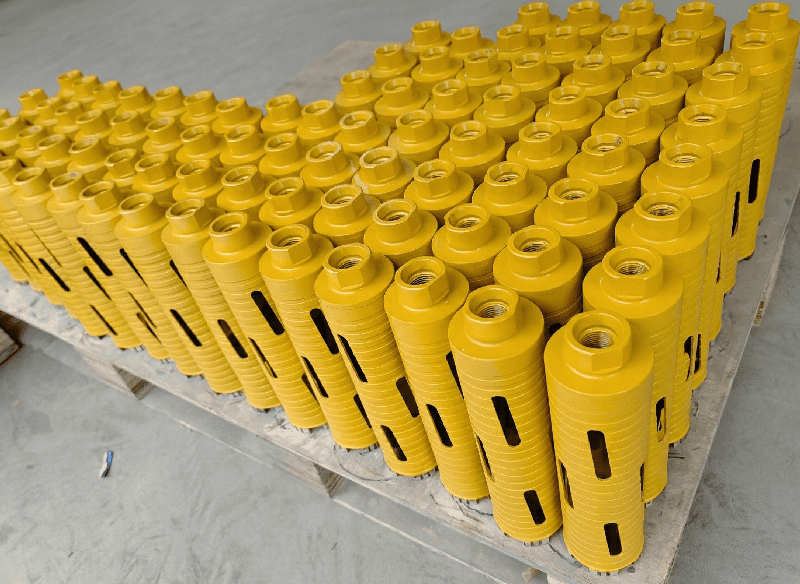
It must be explicitly stated that the “thread” discussed in this report does not refer to the threaded interface connecting the drill rig (such as 5/8-11 UNC or 1-1/4″-7 Shanks/Arbors). Instead, it refers specifically to the Spiral/Threaded Body structure precision-machined onto the outer cylindrical surface of the steel barrel. This design transforms the barrel itself into an active functional component, fundamentally altering the physical dynamics of the drilling process through the Archimedes screw pumping principle.
Market Phenomenon Analysis: The Supply Shortage of “Threaded Bits.”
According to in-depth industry research data, Threaded Matrix Core Bits (hereinafter referred to as “Threaded Bits”) have triggered a strong purchasing wave in the Chinese domestic market and select export markets. Order lead times for some top-tier matrix processing factories have exceeded three months. This state of continuous hot sales (persisting for over three months with a backlog) is rare in the industrial consumables sector.
This phenomenon is not mere marketing hype but is driven by the actual usage experience of End-users. Compared to traditional bits, Threaded Bits demonstrate overwhelming advantages in the portability of handheld operations, stability in deep-hole tasks, and adaptability to harsh working conditions. This report aims to deconstruct and analyze this technological phenomenon from the dimensions of manufacturing, engineering mechanics, and application scenarios.
Structural Engineering Analysis of the Threaded Matrix
The core of the Threaded Matrix lies in altering the mass distribution, surface area, and fluid contact interface of the drill barrel through Machining or forming processes. This structural change brings about a leap in physical performance.

Geometric Parameters and Manufacturing Process
The manufacturing of the Threaded Matrix is not random grooving but engineering design based on precision calculation. According to manufacturer technical disclosures, the geometric parameters of the thread structure primarily include the following key dimensions:
- Groove Width: Industry standards typically control this between 3.0 mm and 5.0 mm. This width is a balance between chip particle size and barrel strength. If the groove is too narrow, large concrete debris can form a “bridging” effect inside the groove, causing blockage; if too wide, it weakens the radial stiffness of the steel tube, leading to deformation at high rotational speeds.
- Pitch: The Lead of the spiral line is the key factor determining chip evacuation speed. Common pitch specifications include 10 mm, 15 mm, and 20 mm, and variable pitch designs exist.
- Small Pitch (10mm): Provides denser spiral channels, increasing the matrix surface area, primarily strengthening cooling functions and fine dust control.
- Large Pitch (20mm): Provides greater axial transport velocity, suitable for rough processing scenarios that generate large debris particles.
- Concentricity: High-precision machining of the Threaded Matrix requires extreme Concentricity. Since the surface of the barrel is cut, any uneven mass distribution will generate severe centrifugal vibration at thousands of RPM. Premium Threaded Bits, through high-precision turning, utilize the redistribution of mass to suppress the harmonic vibration of long-tube bits, achieving better dynamic balance than smooth bits.
Dynamic Mechanism: The Archimedes Screw Pumping Effect
Debris evacuation in traditional smooth bits relies entirely on the pressure flush of the cooling fluid (water or air). In deep holes or Dry Drilling conditions, fluid pressure often decays with depth, causing bottom debris to fail to discharge in time, forming a “rock powder cushion” that drastically increases friction.
Threaded Bits introduce a mechanical transport mechanism via the spiral structure on their outer surface:
- Active Evacuation: When the bit rotates, the spiral groove acts as an Archimedes’ Screw. Even with insufficient fluid pressure, the rotating groove walls exert an upward axial component force on the debris, forcibly lifting it along the groove to the exterior of the hole.
- Anti-Jamming Mechanism: This auxiliary evacuation function significantly reduces the risk of Jamming due to debris blockage. Particularly when drilling reinforced concrete, the gelatinous mixture formed by steel swarf and concrete powder easily adheres to smooth tube walls, whereas the spiral grooves act like a reamer, continuously scraping and discharging these sticky substances.

Thermodynamic Advantages: Heat Dissipation, Surface Area, and Turbulence
Heat is the primary cause of diamond tool failure. Overheating leads to matrix softening and diamond Graphitization.
- Doubled Dissipation Area: The cutting of spiral grooves significantly increases the outer surface area of the barrel (similar to cooling fins on an engine), greatly improving heat exchange efficiency with the cooling medium.
- Fluid Turbulence: In dry drilling, the high-speed rotating threads create strong air turbulence within the annular space between the bit and the hole wall, breaking the stagnant hot air boundary layer and enhancing convective cooling. In wet drilling, the threads guide water flow to cover the tube wall more uniformly and accelerate the discharge of slurry carrying heat.
Lightweighting and Ergonomics
The thread machining process is essentially a process of removing excess steel, which directly leads to a reduction in bit weight.
- Reduced Operator Fatigue: For the increasingly popular Hand-held Core Drills (especially lightweight brushless motor models), the reduction in bit weight directly lowers the load on the operator’s wrist, making long-duration overhead or lateral operations possible.
- Expanded User Base: Lighter weight and easier controllability allow professional-grade coring tools to penetrate non-professional markets, such as DIY Garden Renovation.
Taxonomic Research of Threaded Matrices: Structure and Application
Based on different matrix structural designs, Threaded Bits can be subdivided into “Dry Drill Type” and “Wet/Dry Dual-Use Type.” These two types possess fundamental differences in wall structure, thread count, and application scenarios.
Threaded Dry Drill Bits
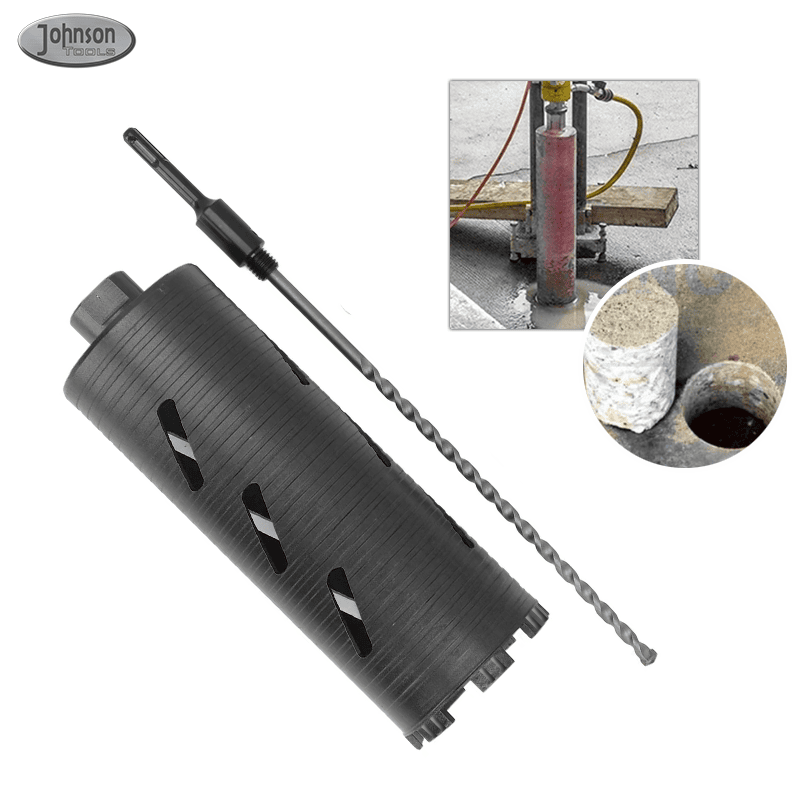
Designed specifically for waterless or micro-water conditions, commonly used for drilling soft or abrasive materials like brick walls and blocks.
- Matrix Features:
- Outer Round Thread: Features typical 3-5mm wide spiral grooves.
- Long Slanted Holes: This is the most distinct identifying feature of Threaded Dry Drills. Symmetrical, long strip-shaped slanted holes are cut into the tube wall.
- Fluid Dynamic Function of Long Slanted Holes:
- Air Circulation: These holes allow air to flow freely between the interior of the drill barrel and the exterior annular space, maximizing cooling airflow.
- Dust Escape: During dry drilling, large amounts of dust can escape from the interior into the spiral grooves through these slanted holes, and then be carried out by the spiral grooves, preventing dust compaction inside.
- Specifications: Common lengths include 150mm, 200mm, 250mm, 370mm, and 450mm, adapting to various wall thicknesses.
Threaded Wet/Dry Dual-Use Drill Bits
This type represents the ultimate in Versatility, capable of dry drilling brick walls and wet drilling high-strength reinforced concrete.
- Matrix Features:
- Solid Wall: Unlike dry drills, the tube wall of dual-use bits typically has no long slanted holes. This is to maintain water pressure during wet drilling, ensuring cooling water reaches the diamond segments at the bottom rather than leaking out midway.
- Fixed Pitch: The industry typically adopts a standard pitch of 10 mm.
- Multi-Start Threads Technology:
- Classified by thread count: Single-head, Double-head, Triple-head.
- Multi-Head Theory: Theoretically, multi-head threads (e.g., four or five heads) have a larger helix angle and faster chip evacuation.
- Engineering Reality: Manufacturers point out that for bits under 450mm in length, the evacuation advantage of multi-head threads is not significant, but manufacturing costs increase notably. Therefore, Triple-head or fewer is the optimal choice for cost-effectiveness; blindly pursuing four or five heads is not recommended.
- Environmental Advantages (Dust & Noise Reduction): In urban underground utility maintenance or interior renovation, using the wet drilling capability effectively suppresses dust (dust reduction). Furthermore, smooth chip evacuation reduces the secondary grinding noise between the bit and debris (noise reduction) .
Segment Topology: The Determinant of Cutting Efficiency
The matrix handles evacuation and stability, while the Diamond Segment/Tooth handles rock breaking. The Threaded Matrix must be paired with specific segment structures to maximize efficacy. The three mainstream segment types are: Great Wall, Turbo, and Big U.
Great Wall Segment (Castle Segment)
Named for its resemblance to the battlements of the Great Wall of China, featuring a serrated or castellated design.
- Structural Mechanics: The top grooves reduce the initial contact area, greatly increasing Point Pressure. This allows the bit to “bite” into smooth stone surfaces more easily, ensuring fast starting positioning.
- Recommended Combination: Manufacturers strongly recommend the Single Head Threaded Matrix + Great Wall Segment combination. This configuration is structurally simple, low-cost, and durable, offering extremely high cost-performance for general-purpose drilling tasks.

Turbo Segment (Turbine Tooth)
The side of the Turbo segment features corrugated or slanted Turbo Grooves.
- Fluid Dynamics: The side grooves provide micro-channels for cooling water and fine rock powder, maintaining fluid lubrication even when the segment is tight against the hole wall.
- Cutting Performance: The Turbo design reduces lateral friction resistance, typically used in scenarios pursuing high drilling speeds. While a common configuration on Threaded Bits, it is slightly less recommended than the specific combinations of Big U and Great Wall.
Big U Segment (Large U-Tooth)
This segment type features a wide U-Slot between adjacent segments.
- Evacuation Capacity: The wide U-slot serves as a massive debris evacuation channel, allowing large concrete particles and steel cuttings to leave the cutting interface rapidly.
- Cooling Efficiency: Water flow can wash directly to the cutting bottom without obstruction, offering the best cooling effect.
- Best Partner: Manufacturers specifically recommend the Triple Head Threaded Matrix + Big U Segment combination (especially for specs under 120mm). The high-efficiency transport capability of the triple thread matches perfectly with the massive debris volume generated by the Big U segment. This is the high-performance solution for deep holes and heavily reinforced concrete.
Table 1: Recommended Configuration Matrix for Threaded Matrix & Segment Structure
| Recommendation | Matrix Type | Segment Structure | Advantage Analysis | Application Scenario |
| High Value Scheme | Single Head Threaded Matrix | Great Wall (Castle) | Structurally solid, fast start, low cost | General drilling, Brick/Concrete structures |
| High Performance Scheme | Triple Head Threaded Matrix | Big U Segment | Extremely fast evacuation, optimal cooling, anti-jamming | Reinforced concrete, deep holes, hard stone |
Manufacturing Constraints and Specification Standardization
Despite the clear advantages of Threaded Bits, their manufacturing process (specifically, thread turning) is strictly limited by physical laws, which directly affects market specification distribution.
The Contradiction of Diameter and Ovality
As the bit diameter increases, the radial stiffness of the steel tube decreases relative to its circumference. When machining threads on large-diameter thin-wall steel tubes, cutting forces cause elastic or plastic deformation of the tube, resulting in “Matrix Ovality.”
- Golden Size Range (<120mm): Domestic market specifications are highly concentrated in nine sizes: 32mm, 40mm, 51mm, 56mm, 63mm, 76mm, 83mm, 102mm, and 120mm [^1]. Within this range, tube stiffness is sufficient to resist machining deformation, resulting in high finished precision and optimal cost-performance.
- The Trap of Large Diameters (>120mm): Although market demand for large specs like 120mm, 140mm, 160mm, and 180mm is increasing, manufacturers explicitly state that these sizes are extremely difficult to machine. Ovality is hard to control, leading to high scrap rates and surging costs. Therefore, from a producer’s perspective, promoting Threaded Bits larger than 120mm is not advocated. For large apertures, traditional smooth bits or using thicker-walled tubing (sacrificing the weight advantage) may be more rational choices.
Regional Differences in Length Specifications
- Domestic Market (China): Tends toward long bits, with standard lengths mostly being 370mm or 450mm, adapting to common wall thicknesses in Chinese architecture.
- Export Market: Specifications are more complex and show a trend toward “Short Bits,” mostly under 300mm in length. This may relate to foreign lightweight operation habits or specific logistics/distribution standards.
Deep Analysis of Application Scenarios
Building Plumbing and HVAC Installation

In the installation of air conditioning holes, gas pipes, and water supply/drainage pipes, the hole diameter precision directly affects sealing effectiveness. The high concentricity design of Threaded Bits ensures hole roundness, reducing subsequent caulking work. Their dry/wet dual-use characteristic offers flexibility: workers can choose dry drilling (with dust extraction) in finished interiors or wet drilling (for speed) in unfinished rough shells.
Urban Underground Utility Retrofit
In non-excavation or micro-excavation underground network maintenance, space is confined and sensitive to environmental pollution. The wet drilling capability of Threaded Bits effectively reduces dust. Simultaneously, their efficient chip evacuation is particularly crucial in Horizontal Drilling, as horizontal holes cannot utilize gravity for evacuation and must rely on the mechanical transport of the threads.
Geological Sampling and Deep Hole Operations
Geological exploration requires obtaining intact core samples. Long-barrel Threaded Matrix bits excel in deep-hole operations: they act like a screw conveyor, continuously transporting rock powder from the hole bottom to the orifice, preventing jamming or core abrasion caused by powder accumulation, thus guaranteeing sampling integrity and success rates.
DIY and Garden Renovation
With the lightweighting of tools, more non-professional users are beginning to undertake garden renovations (such as installing posts in stone ground) themselves. Threaded Bits paired with brushless handheld drills lower the operational threshold, allowing non-professionals to complete concrete or stone drilling tasks with relative ease.
Conclusion and Industry Recommendations
The popularity of “Threaded Matrix Diamond Core Bits” is not accidental; it is a successful convergence of materials science, fluid dynamics, and structural mechanics in the field of drilling tools. It solves the pain points of traditional smooth bits regarding chip evacuation, heat dissipation, and precision control, demonstrating incomparable advantages, particularly in small-to-medium diameter (<120mm) applications.
Core Recommendations for Industry Practitioners:
- Terminology Standardization: During procurement and sales, strictly distinguish between “Threaded Shank/Interface” and “Threaded Matrix/Body” to avoid confusion.
- Selection Strategy:
- Users seeking extreme cost-performance should prioritize Single Head Threaded Matrix + Great Wall Segment.
- For high-strength reinforced concrete or deep hole tasks, select Triple Head Threaded Matrix + Big U Segment.
- Avoid Pitfalls: Unless there is a very specific custom requirement with an ample budget, avoid selecting Threaded Bits larger than 120mm, as ovality issues caused by machining will severely impact user experience and cost-efficiency.
- Equipment Pairing: Fully leverage the lightweight advantage of Threaded Bits by promoting them as the standard configuration for Brushless Handheld Core Drills to maximize their ergonomic value.
In summary, the Threaded Matrix Diamond Core Bit represents a significant direction in the development of diamond drilling tools toward refinement and functionalization, supported by solid engineering foundations underlying its market heat.
Here is the professional English translation, polished for a business context to sound persuasive and native.
Contact Us: Secure Capacity & Seize the Market Advantage
As highlighted in this report, the market for Threaded Matrix Core Bits is experiencing a boom, with premium production capacity often facing lead times of several months. At Johnson Tools, we have optimized our production lines through lean manufacturing to ensure a stable supply across the “Golden Size Range” of 32mm–120mm.
Don’t let long lead times compromise your project schedules or miss your peak sales season. We offer priority production scheduling and expedited shipping channels for our long-term partners. Whether you are a distributor seeking volume purchasing or a contractor in urgent need of stock, we are your reliable inventory backbone.
Get our latest Stock List and Request for Quotation (RFQ) today:
- 24-Hour Hotline: +86-18936085316
- Online Inquiry: https://diatoolscn.com/
- Email: sales@diatoolscn.com