Skip to main content Skip to footer

I. Introduction: Resolving Technical Bottlenecks in Modern Stone Edge Profiling
In modern architectural decoration, high-end countertop fabrication, and commercial exterior cladding, the utilization of high-hardness, brittle materials—such as quartz, granite, engineered ceramics, and sintered stone—has become a standard. However, during edge profiling, shaping, and chamfering, fabricators frequently encounter severe technical bottlenecks. Conventional machining tools often cause edge chipping, deep surface scratching, and geometric profile distortion, which directly plunges product yield rates and inflates manual rework costs.
To achieve flawless, high-precision edge profiles under rigid project timelines, selecting an industrial-grade stone edge grinding wheel is paramount. The internal manufacturing process and structural accuracy of the tool dictate the final surface delivery quality and heavily impact the total operational cost of a fabrication facility. As a premier diamond tools manufacturer, our factory has driven a critical transition from traditional electroplated tools to advanced vacuum brazing technology. This engineering iteration offers a breakthrough in tool longevity and triggers a significant leap in stone processing efficiency.

II. Technical Deep Dive: Vacuum Brazed vs. Electroplated Diamond Grinding Wheels
In industrial stone milling and edge profiling, the chosen manufacturing method fundamentally governs how diamond crystals are bonded to the steel core. A microscopic and mechanical analysis highlights the absolute superiority of a vacuum brazed diamond grinding wheel over traditional electroplated alternatives.
- Microscopic Bonding Mechanisms: The traditional electroplating process relies strictly on the physical encapsulation of a nickel metal matrix to “trap” diamond particles. This mechanical grip features no chemical interaction between the diamond and the nickel substrate. Under high-speed, heavy-load stone grinding, friction and shear stress quickly wear down the nickel layer, causing premature diamond stripping and rapid tool failure. Conversely, our specialized factory uses high-temperature vacuum furnaces where an active brazing alloy induces a chemical metallurgical reaction on the diamond surface, creating a robust carbide transition layer. This true chemical bonding delivers an ultra-high-strength matrix grip, ensuring the diamond grains remain structurally secure even under heavy impact cutting.
- Diamond Exposure Rate & Cutting Efficiency: These distinct bonding physics directly alter the active diamond exposure on the wheel’s surface. To maintain a physical grip, electroplated wheels must embed diamond particles up to 50% to 60% of their volume, resulting in a low exposure height and minimal chip clearance space, which triggers debris clogging and thermal slab burning. In contrast, thanks to the metallurgical bond strength, the matrix layer of a vacuum brazed wheel only needs to cover 20% to 30% of the diamond volume. This yields an exceptionally high diamond exposure rate of 70% to 80%. The vast chip clearance and pronounced grain protrusion allow each diamond grit to achieve a deeper effective depth of cut and seamless swarf evacuation.
- Lifespan and Processing Efficiency on Hard Stone: Comparative testing data confirms that when processing high-hardness quartz and granite slabs continuously, the vacuum brazed architecture significantly lowers cutting resistance. The operational lifespan is extended by 3 to 5 times compared to an electroplated tool of identical specifications. For automated production lines, this drastically minimizes downtime tied to frequent tool replacements, pushing overall processing throughput up by over 100%.

III. Diamond Profile Wheel Selection Guide: Matching Geometry to Engineering Needs
To satisfy diverse architectural aesthetics and engineering mandates, the industrial diamond profile wheel is manufactured in a comprehensive array of standard and bespoke geometric contours. As an essential granite profiling tool, selection must align precisely with the intended application:
- France Side (Ogee Profile – JSQ-36): Characterized by an elegant, double-reverse curve. It is the premier choice for luxury marble countertops, high-end residential window sills, and artistic threshold stone edge configurations.
- Roman Column Profile (JSQ-37): A classic antique architectural profile featuring alternating concave and convex lines. Engineered as a specialized roman column shape diamond stone grinding wheel, it is calibrated for high-precision grooving on commercial exterior wall trim, premium column capitals, and ornate baseboards.
- Parallel Wheel / Flat Edge (JSQ-38): Features a standard 90° vertical grinding face. It is primarily utilized for precise straight-edge seam trimming at joints, leveling irregular concrete walls, and rapid bulk material removal before custom profiling stages.
- V-Type Wheel / Bevel Profile (JSQ-39): Engineered with a symmetrical V-shaped chamfering surface. It is purpose-built for slotting dry-hang architectural stone panels, creating anti-slip grooves on stair treads, and executing sharp V-groove internal chamfers on custom geometric stone parquets.

IV. Source Factory Capabilities: OEM Customization and Quality Assurance
Leveraging a fully integrated, state-of-the-art manufacturing infrastructure, our factory does not merely supply standard stone processing factory specialized edge tools; we provide extensive OEM/ODM support to fabricate custom profiles based on client-submitted CAD drawings.
As an established industrial-grade stone chamfering wheel source factory, we subject every production batch to rigorous concentricity and dynamic balancing evaluations. This ensures that our wheels maintain near-zero vibration profiles when operating at high speeds (up to 10,000 RPM) on CNC machining centers or handheld angle grinders. By eliminating tool chatter, we prevent wavy surface finishes and micro-chipping, providing global B2B distributors and heavy-duty stone processing plants with high-tier industrial cutting solutions.
V. Case Study: Maximizing Production Throughput for a North American Fabrication Center
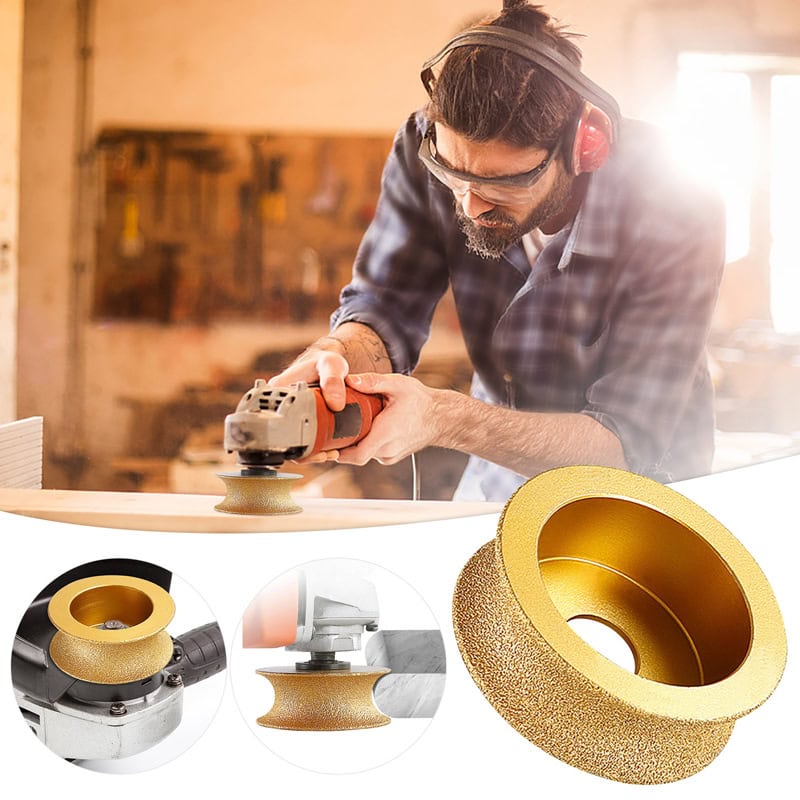
- Project Background: A top-tier commercial stone fabrication center in North America specializes in mass-producing 30mm thick quartz and natural granite countertops for large-scale hospitality and multi-family residential projects.
- The Technical Challenge: The facility’s automated CNC production lines originally utilized standard electroplated diamond profiling wheels. Due to the high-intensity, continuous edge-milling requirements, the average tool life stalled at just 500 linear meters. When processing high-quartz-content slabs, thermal stress caused rapid diamond stripping, pushing edge-chipping and surface scratch rejection rates up to 15%. This forced frequent, unscheduled tool-change stoppages and excessive manual post-polish corrections, severely bottlenecking delivery schedules and inflating scrap costs.
- The Factory-Engineered Solution: Our engineering department audited the client’s CNC machinery parameters (operating at 8,000–10,000 RPM) and formulated a tailored tooling configuration. We supplied a high-performance array of custom Vacuum Brazed France Side Wheels (JSQ-36) and Parallel Wheels (JSQ-38). The diamond grit distribution was optimized specifically for high-speed aggressive cutting, and the overall profile tolerances were locked within a strict ±0.1mm range.
- Quantifiable Results & Feedback: * Unprecedented Lifespan Extension: The continuous cutting lifespan of a single vacuum brazed profile wheel surpassed 2,200 linear meters—a 4.4x increase over the previous electroplated tooling.
- Drastic Yield Optimization: Capitalizing on the chemical metallurgical bond and expansive chip clearance, thermal burn marks and edge fractures dropped below 2%. The exceptional edge smoothness significantly reduced the time required for subsequent fine-polishing stages.
- Comprehensive Cost Reductions: Tool-change downtime on the production floor was slashed by 75%. Final cost-benefit accounting revealed a 35% reduction in total edge-processing costs per meter. Consequently, the enterprise finalized an exclusive agreement, establishing our factory as their core diamond tools source supplier.